
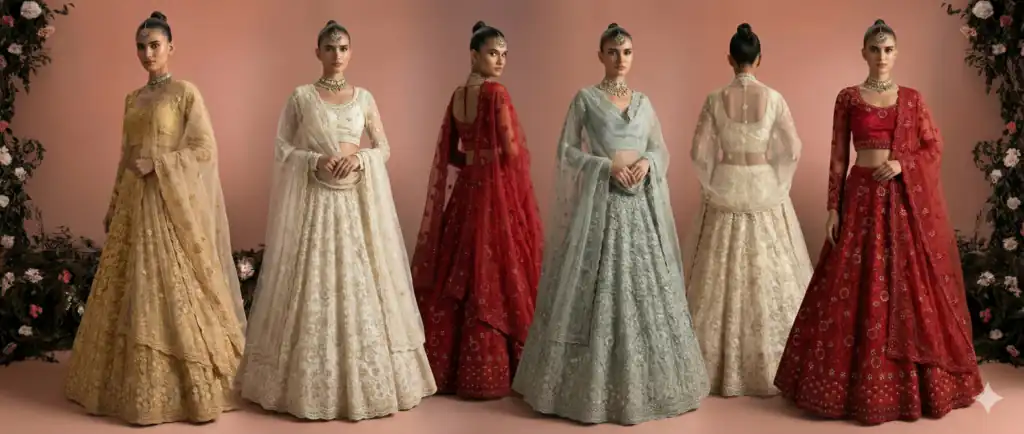
Introduction: Your Wedding Season, Your Lehenga Story
The wedding invitations are starting to pile up. Your calendar is marked with dates that matter — your best friend’s big day, your cousin’s destination wedding, the festival celebration that happens once a year, and maybe, just maybe, your own celebration is on the horizon.
Every Indian woman knows that with wedding season comes one universal truth: you need the perfect lehenga.
But walking into a boutique or scrolling through endless online options can feel overwhelming. There are so many styles, so many colors, so many price points. Your mother says one thing, your best friend says another, and that influencer on Instagram makes it all look so easy.
We get it. At IndiaNari, we have helped thousands of women find their perfect lehenga, and we have learned a few important truths along the way:
- The perfect lehenga is not about following every trend
- It is not about choosing what is most expensive or most elaborate
- It is not about wearing what looks best on someone else
The perfect lehenga is the one that makes YOU feel extraordinary.
But we also know that feeling extraordinary requires making informed choices. Which lehenga style works for your body type? Which fabric is right for the season and venue? Which color will look best in photographs? Which embellishment level matches the occasion?
This guide answers every single one of those questions.
We have poured everything we know about lehengas, Indian weddings, and helping women look their absolute best into this comprehensive guide. Consider it your personal lehenga consultant — available anytime, at your service.
Let us help you find the lehenga that was made for you.
Table of Contents
- Understanding the Lehenga Landscape
- Decoding Body Types: Finding Your Perfect Lehenga Silhouette
- The Ultimate Lehenga Style Guide for Every Body Type
- Fabric Fundamentals: Choosing the Right Material
- Color Psychology: Finding Your Perfect Shade
- Embellishment Guide: From Minimal to Maximal
- Occasion Decoder: Matching Your Lehenga to the Event
- The Draping Dilemma: Skirt, Palazzo, or Sharara?
- Accessorizing Like a Pro
- The Bridal Lehenga vs. The Guest Lehenga: Understanding the Difference
- Shopping Smart: New vs. Ready-to-Wear
- Alterations and Fitting: The Secret to Perfection
- Caring for Your Lehenga
- Common Lehenga Mistakes and How to Avoid Them
- IndiaNari’s Curated Wedding Season Collection
- Final Thoughts and FAQs
1. Understanding the Lehenga Landscape
Before we dive into the specifics, let us set the stage by understanding what lehengas are available in the modern Indian fashion landscape.
What Exactly Is a Lehenga?
A lehenga consists of three main components:
The Choli (Blouse): The fitted or structured top that covers your upper body. cholis range from traditional short sleeves to contemporary off-shoulder designs, from modest high necks to dramatic backless styles.
The Lehenga Skirt: The flowing, pleated, or flared bottom that is the signature element of this ensemble. Skirts can be heavily embellished or minimally detailed, tightly pleated or loosely flowing, traditional or contemporary in their construction.
The Dupatta (Veil or Scarf): The flowing fabric that completes the look, draped over the head, over one shoulder, or creatively styled to enhance the overall silhouette.
Types of Lehengas You Need to Know
Bridal Lehenga: The most heavily embellished, ornate version. Typically features extensive zardosi, stone work, resham embroidery, and often includes a matching or contrasting dupatta. Traditionally red, though contemporary brides are embracing pastels, jewel tones, and even white.
Lehenga Choli: The standard, versatile lehenga that works for brides and guests alike. Can range from heavily embellished to minimally decorated.
Cape Lehenga: A modern interpretation featuring a cape attached to the choli or worn separately over the lehenga. Creates a dramatic, fashion-forward silhouette perfect for sangeet, cocktail, and contemporary wedding events.
Jacket Lehenga: Features a structured jacket — often heavily embellished — layered over the choli. Popular for winter weddings and reception functions.
Panelled Lehenga: Constructed with vertical panels of fabric that create a slimming, elongating effect. Particularly flattering for various body types.
Mermaid/Fishtail Lehenga: A fitted silhouette that flares dramatically at the bottom, creating a fishtail effect. Glamorous, dramatic, and perfect for reception functions.
A-Line Lehenga: The most universally flattering silhouette. Fitted at the waist and hips, flaring gently to the hem in an A-line shape. Works for virtually every body type and occasion.
Circular Lehenga: Features a full, circular cut that creates maximum flare and movement. Dramatic, grand, and perfect for women who want significant volume.
Asymmetric Lehenga: Features an asymmetric hemline or unconventional construction. Contemporary, fashion-forward, and perfect for the modern bride or guest who wants to stand out.
2. Decoding Body Types: Finding Your Perfect Lehenga Silhouette
Understanding your body type is the foundation of finding a lehenga that makes you look extraordinary. Let us break this down in a way that feels empowering, not limiting.
The Hourglass Figure
Your characteristics: Your shoulders and hips are roughly equal in width, with a clearly defined, narrower waist. Your curves are your asset.
Best Lehenga Styles:
- A-Line Lehenga: The A-line silhouette honors your natural curves beautifully. The fitted waist emphasizes your narrowest point, while the gentle flare skims rather than clings to your hips and thighs.
- Mermaid/Fishtail Lehenga: If you want to embrace your curves completely, a mermaid silhouette celebrates the hourglass shape with elegant drama.
- Circular Lehenga: Full, dramatic flare creates balance with your curves without overwhelming your frame.
What to avoid: Lehengas with no waist definition or excessive volume at the hip that could add unnecessary width.
Styling tip: A belt or kamarband at your natural waist creates additional definition and draws attention to your beautiful curves.
The Pear-Shaped Figure
Your characteristics: Your hips are wider than your shoulders, with weight concentrated in your lower body. You likely have a defined waist and a curvier hip-to-thigh area.
Best Lehenga Styles:
- A-Line Lehenga: The A-line is your best friend. It flows gracefully over your hips, creating a smooth, elongated line from waist to hem.
- Panelled Lehenga: Vertical panels create a slimming, elongating effect that works beautifully for pear shapes.
- Lehenga with Longer Choli: A longer choli that extends past your hip bone and begins the flare above your widest point creates a more balanced silhouette.
What to avoid: Lehengas with heavy embellishment on the hips or heavy fabric that clings to your lower body.
Styling tip: Choose cholis with embellishment at the neckline and yoke to draw the eye upward. Use your dupatta strategically to create balance between your upper and lower body.
The Apple-Shaped Figure
Your characteristics: Weight is carried primarily around your midsection, with shoulders and hips that may be similar in width. You likely have beautiful legs and arms as assets.
Best Lehenga Styles:
- A-Line Lehenga: A well-fitted A-line in a draping fabric creates a beautiful flowing line that skims rather than clings to your midsection.
- Lehenga with High Waist: A high-waisted lehenga that sits below your bust and flows past your midsection entirely creates an elongating, slimming effect.
- Cape Lehenga: The cape creates a structured, vertical line through your torso while the flowing lehenga skirt skims gracefully below.
What to avoid: Lehengas with heavy embellishment across the midsection or waistbands that sit at your natural waist if they create a horizontal line at your widest point.
Styling tip: A deep V-neck choli draws the eye vertically and inward, creating a flattering, elongated line. Keep embellishment focused on your upper body and the lehenga hem.
The Rectangle/Straight Figure
Your characteristics: Your shoulders, waist, and hips are roughly equal in width, with minimal curves. You likely have a long, lean torso and legs.
Best Lehenga Styles:
- Circular Lehenga: Full flare creates the illusion of curves and adds volume where your body naturally has less.
- Layered Lehenga: Multiple layers add dimension and the impression of curves to a straighter frame.
- Mermaid Lehenga: A dramatic mermaid silhouette actually works beautifully on rectangle figures, creating curves through the garment rather than relying on your natural shape.
What to avoid: Very straight, minimal A-line lehengas without flare that emphasize a naturally straight silhouette.
Styling tip: Add a statement belt or kamarband to create waist definition where your body has less natural definition. Choose embellishment that adds interest to both your upper and lower body.
The Inverted Triangle Figure
Your characteristics: Your shoulders are broader than your hips, with a stronger upper body and narrower lower body. Athletic women often have this body type.
Best Lehenga Styles:
- Circular Lehenga: Maximum flare at the hem creates balance with your broader shoulders.
- Layered Lehenga: Layers add volume and visual weight to your lower body, creating balance with your upper body.
- Lehenga with Embellished Hem: Heavy embellishment at the hem draws the eye downward, creating visual balance between your upper and lower body.
What to avoid: Cholis with very wide necklines or heavy shoulder embellishment that further broadens your upper body.
Styling tip: Keep your choli neckline narrower — V-neck, halter, or high neck — to visually narrow your shoulder line. Draw attention downward with bold juttis or embellished shoes.
3. The Ultimate Lehenga Style Guide for Every Body Type
Now that you understand body types, let us translate that into specific, actionable style guidance.
For Petite Frames (Under 5’2″)
The goal: Create the illusion of height and avoid being overwhelmed by fabric.
Your best choices:
- A-Line Lehenga in midi or floor-length with proper heel height
- Lightweight fabrics that do not add bulk
- Vertical embellishment patterns that draw the eye upward
- Monochrome or tonal color schemes that create continuous vertical line
What to avoid:
- Excessively heavy or stiff fabrics
- Very short cholis with very long lehengas (disproportionate)
- Large-scale prints that overwhelm your frame
- Heavy dupattas that add bulk
The heel solution: If you want floor-length, wear 3-4 inch heels. If you prefer flats, have your lehenga hemmed to midi length. Both look stunning when done correctly.
For Tall Frames (5’7″ and Above)
The goal: Use your height to carry dramatic, flowing lehengas that shorter frames cannot.
Your best choices:
- Full-length circular lehengas with dramatic flare
- Heavily embellished cholis and lehengas — your height can carry the visual weight
- Layered and tiered lehengas that add dimension
- Bold, all-over prints and heavy embellishment
What to avoid:
- Very short lehengas that cut your height visually
- Minimal, straight-cut lehengas that do not use your height advantage
- Being afraid of maximum drama — your frame can handle it
The advantage: You can wear lehengas the way they were designed to be worn — with fabric that sweeps the floor, with dupattas that flow dramatically, with embellishment that makes a statement.
For Plus-Size Figures
The goal: Find a lehenga that celebrates your beautiful body with the right silhouette, fabric, and fit.
Your best choices:
- Well-fitted A-line lehengas with proper tailoring
- High-quality fabrics with excellent drape — georgette, crepe, soft silk
- Vertical lines, panelling, and column-like construction that elongate
- Rich, deep colors that photograph beautifully and create a stunning visual
- Embellishment concentrated on the choli to draw attention upward
What to avoid:
- Lehengas that are too tight or restrictive
- Very clingy fabrics that reveal rather than flatter
- Excessively stiff fabrics that add bulk without shape
- Heavy embellishment on areas you prefer to minimize
The fit truth: The single most important factor for plus-size women is fit. A well-fitted lehenga in a beautiful fabric will always look more stunning than an ill-fitting lehenga in a more expensive fabric. Budget for alterations.
4. Fabric Fundamentals: Choosing the Right Material
The fabric of your lehenga determines how it drapes, moves, photographs, and feels. Here is your complete fabric guide.
Silk: The Royal Choice
Best for: Bridal wear, grand occasions, winter weddings
Vibe: Luxurious, traditional, opulent
Varieties:
- Kanjivaram Silk: The most prestigious South Indian silk, known for rich colors and gold zari work
- Banarasi Silk: From Varanasi, featuring intricate woven patterns and gold work
- Tussar Silk: Earthy, textured, more relaxed than mulberry silk
- Art Silk: Silk-look fabric at a more accessible price point
Pros: Beautiful drape, rich appearance, holds embellishment well, photographs magnificently
Cons: Requires dry cleaning, can be heavy, needs careful storage
Velvet: The Winter Royal
Best for: Winter weddings, evening functions, dramatic statements
Vibe: Luxurious, warm, dramatic
Pros: Exceptionally warm, rich appearance, unique tactile quality, stands out in any crowd
Cons: Not suitable for summer or outdoor functions in warm weather, can be heavy, requires careful maintenance
Georgette: The Flowing Favorite
Best for: Year-round wear, destination weddings, events with dancing
Vibe: Romantic, graceful, movement-oriented
Varieties:
- Heavy Georgette: More structured, holds shape better
- Crepe Georgette: Slightly matte finish, elegant
- Chiffon Georgette: Ultra-light, ethereal, flowing
Pros: Beautiful movement, drapes flawlessly, comfortable for long events, photographs well
Cons: Can cling in humid conditions, may require lining
Net and Organza: The Dramatic Choice
Best for: Cocktail functions, sangeet, contemporary weddings, reception
Vibe: Modern, ethereal, high-fashion
Pros: Creates stunning layered effects, lightweight despite dramatic appearance, unique visual quality
Cons: Requires careful handling, may need additional lining for modesty
Chanderi: The Elegant Classic
Best for: Daytime functions, summer weddings, sophisticated occasions
Vibe: Elegant, understated, refined
Pros: Subtle sheen, comfortable in warm weather, looks expensive without being ostentatious
Cons: Delicate fabric requires careful handling
Cotton and Linen: The Summer Saviors
Best for: Daytime summer weddings, outdoor functions, comfort-priority occasions
Vibe: Relaxed, breathable, effortlessly chic
Pros: Extremely comfortable, breathable, perfect for summer
Cons: May appear too casual for very formal events, limited embellishment options
Fabric and Season Matching Guide
| Season/Event | Recommended Fabrics | Fabrics to Avoid |
|---|---|---|
| Summer Outdoor | Cotton, linen, light georgette | Silk, velvet, heavy net |
| Summer Indoor AC | Georgette, chanderi, light silk | Heavy velvet |
| Winter Outdoor | Silk, velvet, heavy georgette | Very thin fabrics |
| Winter Indoor | Silk, velvet, georgette | Light cotton, chiffon |
| Destination Beach | Light georgette, chiffon | Heavy silk, velvet |
| Daytime Function | Chanderi, cotton silk, light georgette | Heavy velvet, dark colors |
| Evening Function | Silk, velvet, net, organza | Light cotton |
5. Color Psychology: Finding Your Perfect Shade
Color is the first thing people notice about your lehenga. Here is how to choose the shade that makes you look extraordinary.
Understanding Undertones
Every person has either a warm, cool, or neutral undertone. Understanding yours helps you choose colors that make your skin glow.
Warm undertone: Your skin has yellow, golden, or peachy tones. You look best in warm colors — gold, orange, coral, terracotta, yellow, warm pink.
Cool undertone: Your skin has pink, blue, or rosy tones. You look best in cool colors — silver, blue, pink, purple, magenta, cool red.
Neutral undertone: You can wear both warm and cool colors equally well.
The vein test: Look at the veins on your inner wrist in natural light. Blue or purple veins indicate cool undertone. Green veins indicate warm undertone. Both blue and green suggest neutral.
The Ultimate Color Guide by Skin Tone
For Fair/Light Skin:
- Almost every color works beautifully
- You can carry pastels, bright colors, and deep jewel tones with equal grace
- Avoid colors that are too close to your skin tone (very pale yellow, extremely light pink) which can wash you out
For Medium/Wheatish Skin:
- Warm colors like gold, orange, coral, and terracotta are extraordinarily flattering
- Rich jewel tones — emerald, ruby, sapphire — look magnificent
- Pastels in warm undertones (peach, warm pink) work beautifully
For Dusky/Deep Skin:
- Bright, saturated colors are your superpower
- White, gold, orange, fuchsia, and electric blue create stunning contrast
- You can carry off-white, cream, and ivory better than fairer skin tones
- Deep jewel tones — emerald, sapphire, ruby — are absolutely stunning
For Very Dark Skin:
- You have the most flexibility with bold, bright colors
- Gold, white, and silver look extraordinary on your complexion
- You can carry colors that lighter skin tones cannot — wear them with confidence
- Pastels in the right undertone also work beautifully
The Occasion Color Guide
For Brides:
- Traditional: Red, maroon, burgundy
- Contemporary: Pastels (blush pink, lavender, sage), ivory, gold, champagne, white
- Destination: Brighter colors that photograph well in outdoor settings
For Wedding Guests:
- Avoid: Red and white — traditionally reserved for brides
- Safe choices: Jewels, pastels, metallics, vibrant celebration colors
- Bold choices: Fuchsia, mustard, orange, teal — stand out tastefully
For Sangeet/Functions:
- Anything goes — this is your chance to be bold, fun, and expressive
- Sequin lehengas, bright colors, dramatic styles are all appropriate
For Reception:
- Evening glamour: Deep jewel tones, metallics, black (yes, black lehengas are stunning)
- Dramatic silhouettes: Mermaid, cape, heavily embellished
The Most Flattering Colors by Body Type
| Body Type | Most Flattering Colors | Why |
|---|---|---|
| Hourglass | Any — your balanced proportions carry all colors | No restrictions |
| Pear | Darker bottoms, brighter tops | Creates balance |
| Apple | Monochrome, rich jewel tones | Elongates and flatters |
| Rectangle | Bold, bright, contrasting | Adds dimension |
| Inverted Triangle | Dark upper, bright lower | Creates balance |
| Petite | Monochrome, medium tones | Elongates visually |
| Tall | Any — height carries all colors | Maximum flexibility |
| Plus-Size | Rich, deep colors | Photogenic and slimming |
6. Embellishment Guide: From Minimal to Maximal
The embellishment on your lehenga is where craft meets fashion. Here is everything you need to know.
Types of Lehenga Embellishment
Zardosi: Gold or silver metallic embroidery, often combined with beads and stones. The most traditional and royal embellishment style.
- Best for: Bridal wear, very formal occasions
- Vibe: Traditional, opulent, grand
Resham: Colorful silk thread embroidery creating detailed floral and paisley motifs.
- Best for: Wedding functions, festive occasions
- Vibe: Rich, heritage, classic
Sequin: Small shimmering discs sewn onto fabric for sparkle and shine.
- Best for: Sangeet, cocktail, evening functions
- Vibe: Glamorous, festive, dramatic
Mirror Work (Shisha): Traditional Rajasthani craft using small mirrors.
- Best for: Mehendi, boho-themed weddings, casual functions
- Vibe: Traditional, rustic, unique
Stone and Crystal: Preciosa stones, Swarovski crystals, and Kundan work.
- Best for: Bridal, reception, grand evening events
- Vibe: Luxurious, sparkling, high-glamour
Cutwork and Jaali: Intricate cutout patterns creating geometric or floral designs.
- Best for: Contemporary weddings, fashion-forward events
- Vibe: Modern, artistic, sophisticated
Embellishment Placement Strategy
Choli Embellishment:
- Heavy choli embellishment draws the eye to your face and upper body
- Neckline and yoke work is universally flattering
- Back embellishment creates a stunning view from behind
Lehenga Embellishment:
- Heavy embellishment at the hem creates a beautiful visual base
- Scattered or all-over work adds dimension
- Minimal embellishment on lehenga with heavy choli creates balance
Dupatta Embellishment:
- Heavy dupatta with minimal choli creates a statement look
- Contrast embellishment between dupatta and lehenga adds interest
How Much Embellishment Is Right for Your Body Type?
| Body Type | Recommended Embellishment | Why |
|---|---|---|
| Hourglass | All-over or concentrated on choli | Can carry visual weight beautifully |
| Pear | Choli focus, lighter on lehenga | Draws eye upward, balances lower body |
| Apple | Choli focus, vertical lines on lehenga | Elongates, draws eye up |
| Rectangle | All-over to add dimension | Creates curves and visual interest |
| Inverted Triangle | Heavy on lehenga, lighter on choli | Balances upper and lower body |
| Petite | Moderate, smaller-scale work | Avoids overwhelming small frame |
| Tall | Heavy, all-over — height carries it | Maximum impact |
| Plus-Size | Choli focus, quality over quantity | Flattering, not overwhelming |
7. Occasion Decoder: Matching Your Lehenga to the Event
One lehenga does not fit every wedding event. Here is how to dress perfectly for every occasion.
The Wedding Ceremony (Indian Rites)
Appropriate lehenga: Bridal or guest-appropriate, depending on your role
Fabric: Silk, georgette, chanderi
Color: Rich colors, avoid red if you are a guest
Embellishment: Moderate to heavy
Vibe: Respectful, celebratory, appropriate
For brides: Your heaviest, most ornate lehenga. This is your moment.
For guests: A beautiful, celebratory lehenga in a color that honors the occasion without competing with the bride.
The Reception
Appropriate lehenga: Your most glamorous
Fabric: Silk, velvet, net, organza
Color: Deep jewel tones, metallics, black
Embellishment: Heavy, sparkly, dramatic
Vibe: Glamorous, celebratory, show-stopping
This is your opportunity to make an entrance. The reception is evening, the lighting is artificial, and glamour is expected.
The Sangeet
Appropriate lehenga: Fun, expressive, dance-ready
Fabric: Georgette, crepe, net
Color: Bright, bold, celebratory
Embellishment: Sequins, mirrors, fun details
Vibe: Festive, fun, ready to dance
You will be dancing. Choose a lehenga that allows movement. Test your range of motion before committing.
The Mehendi
Appropriate lehenga: Comfortable, colorful, relaxed
Fabric: Cotton, light georgette, linen
Color: Yellow, green, orange, bright prints
Embellishment: Minimal to moderate
Vibe: Happy, colorful, comfortable
This is one of the most fun events. Bright colors, comfortable fabrics, and a joyful spirit are what matters most.
The Haldi
Appropriate lehenga: Anything you do not mind getting permanently colored
Fabric: Cotton, anything washable
Color: Yellow — everything will become yellow
Embellishment: None that you care about
Vibe: Playful, messy, celebratory
Be practical. This is not the event for your expensive lehenga. Wear something you can donate or discard afterward.
The Engagement
Appropriate lehenga: Elegant, semi-formal
Fabric: Silk, georgette, chanderi
Color: Pastels, jewel tones, celebratory colors
Embellishment: Moderate
Vibe: Sophisticated, happy, celebratory
An engagement is formal but not as grand as a wedding. Elegant and beautiful, but not bridal.
Cocktail and Pre-Wedding Parties
Appropriate lehenga: Fashion-forward, contemporary
Fabric: Net, organza, contemporary blends
Color: Trendy, bold, or dramatically dark
Embellishment: Statement-making
Vibe: Modern, chic, Instagram-worthy
These events call for your most fashion-forward choices. This is the time to wear that cape lehenga or that asymmetric hem you have been saving.
8. The Draping Dilemma: Skirt, Palazzo, or Sharara?
Modern lehenga styling offers alternatives to the traditional skirt. Here is what you need to know.
Traditional Lehenga Skirt
The classic. A fitted, flared, pleated skirt that is the signature of lehenga dressing.
Best for: Traditional weddings, bride and family members, classic elegance
Flattering on: All body types when properly fitted
Consideration: Requires more fabric management, can be warm, needs proper petticoat
Lehenga with Palazzo
The bottom half replaced with wide-leg palazzo pants.
Best for: Modern brides, contemporary weddings, comfort-priority events
Flattering on: Most body types
Advantages: More comfortable, easier to move in, contemporary look, easier to manage than skirt
Consideration: Has a more modern, less traditional feel
Lehenga with Sharara
The bottom half replaced with wide, flared sharara pants.
Best for: Sangeet, cocktail, contemporary wedding events
Flattering on: Most body types, especially good for pear and hourglass figures
Advantages: Dramatic, stylish, comfortable, unique
Consideration: Not traditional enough for some wedding ceremonies
Cape or Jacket Style
A cape or structured jacket layered over the lehenga ensemble.
Best for: Reception, cocktail, fashion-forward events, winter weddings
Flattering on: All body types, especially good for apple shapes
Advantages: Dramatic, fashion-forward, warm (for winter), unique
Consideration: More unusual style, ensure it fits the event context
9. Accessorizing Like a Pro
The right accessories transform a beautiful lehenga into an extraordinary one. Here is your complete accessorizing guide.
Jewelry Strategy
For heavy lehenga (bride or grand occasion):
- Choose ONE statement piece — either massive necklace OR dramatic earrings, not both
- Let your jewelry complement rather than compete with your lehenga’s embellishment
- Coordinate metal colors (all gold, all silver, or mixed per tradition)
For moderate lehenga:
- Balance is key — matching necklace and earring set works beautifully
- Add maang tikka or matha patti if appropriate
For minimal lehenga:
- Your jewelry CAN be the statement
- Bold, significant pieces are appropriate
The Jewelry and Neckline Connection
| Choli Neckline | Best Jewelry |
|---|---|
| Deep V | Long pendant necklace, layered chains |
| Round/Sweetheart | Choker or short necklace |
| High Neck | Jhumkas or statement earrings, no necklace needed |
| Off-Shoulder | Broad choker, shoulder-dusting earrings |
| Backless | Front necklace with back detail (double maang tikka) |
Footwear: The Foundation
Juttis and Mojaris: Traditional, elegant, Indian. Embellished ones for functions, simple ones for daily events.
Heels: Platform heels or wedges are best for lehengas — more stable than stilettos, allows for movement.
Flats: Embellished juttis or flats work for daytime events or if you cannot wear heels.
Heel height matters: Your lehenga’s length should be cut for your heel height. If you switch from heels to flats, the hem will hang differently.
The Bag Situation
Potli bags: The most appropriate choice for traditional events. Choose embellished or metallic options for weddings.
Clutches: Work for cocktail and reception events.
Crossbody bags: Generally not appropriate for traditional Indian weddings.
Maang Tikka and Maang
The maang tikka (forehead ornament) adds traditional elegance. It works best with:
- Traditional and semi-traditional lehengas
- Bridal and near-bridal looks
- Events where you are dressed fully in traditional style
It may look out of place with very modern, contemporary lehengas.
10. The Bridal Lehenga vs. The Guest Lehenga: Understanding the Difference
One of the most common questions we get at IndiaNari is: “How do I dress as a wedding guest without looking like I am trying to upstage the bride?”
Let us clear this up completely.
What Brides Traditionally Wear
- Red, maroon, or red-adjacent colors (burgundy, wine, rust)
- Heaviest embellishment in the wedding party
- Most elaborate lehenga they will ever wear
- Gold and Kundan jewelry — traditional bridal sets
- Full traditional styling — head accessories, heavy draping
What Guests Should Do Instead
Colors:
- Avoid red and white entirely — these are for the bride
- Do not wear heavily embellished white, cream, or ivory — brides often wear these
- Choose colors that celebrate without competing
Embellishment:
- Elegant and beautiful, yes
- Heavily embellished enough to look festive, yes
- Bride-level ornate? No
Style:
- Traditional lehengas are absolutely appropriate for guests
- You can wear a heavily embellished lehenga — just not at bride-level
- Modern and contemporary styles are excellent for guests because they read as stylish without being “bridal”
The guest rule of thumb: You should look beautiful, celebratory, and respectful of the occasion. If a stranger at the wedding might momentarily wonder if you are the bride, you have dressed too grandly.
The One Exception
Some families explicitly request that close friends or all wedding guests dress in traditional Indian attire. In this case, follow the guidance you are given. If the invitation specifies “Indian formal attire” or similar, it is an invitation to dress grandly.
When in doubt, ask the bride or her family what they would prefer.
11. Shopping Smart: New vs. Ready-to-Wear
Ready-to-Wear Lehengas
Advantages:
- Immediate availability
- Known quality and construction
- Can see and feel the fabric before buying
- Easier to assess embellishment quality
- Generally more affordable
Disadvantages:
- May require alterations
- Limited customization options
- May need to compromise on exact specifications
Best for: First-time lehenga buyers, budget-conscious shoppers, events where you need the lehenga quickly
Custom-Made Lehengas
Advantages:
- Perfect fit guaranteed (when measured correctly)
- Choose every element — fabric, color, embellishment, silhouette
- Unique to you
- Often higher quality construction
Disadvantages:
- Takes time (weeks to months)
- More expensive
- Cannot see finished product until delivered
- Requires trust in the tailor or designer
Best for: Brides, women with specific visions, those with unusual sizing needs, special occasions where perfection matters
Our Recommendation
For most wedding guests and general occasions, a well-made ready-to-wear lehenga from a trusted source like IndiaNari — paired with professional alterations for perfect fit — gives you the best value and outcome.
For brides and very special occasions, custom or semi-custom (ready-made with customization options) is often worth the investment.
12. Alterations and Fitting: The Secret to Perfection
This section cannot be emphasized enough: fit is everything.
A Rs. 50,000 lehenga that fits poorly will look inferior to a Rs. 15,000 lehenga that fits like it was made for your body.
Common Alterations Needed
Hem adjustment: Floor-length lehengas often need hemming to your specific height with your planned heel height.
Waist adjustment: Taking in or letting out the waistband for a perfect fit.
Choli fitting: Taking in the sides, adjusting armholes, or modifying the neckline.
Dupatta length: Shortening or lengthening dupattas to drape correctly.
Lining adjustments: Ensuring the lining does not pull or create visible lines.
Budget for Alterations
Always budget an additional Rs. 500-2000 for alterations when buying ready-to-wear. This investment transforms how you look.
The Fitting Process
- Buy your lehenga well in advance — at least 4-6 weeks before the event
- Try it on immediately upon delivery to assess what needs alteration
- Take photos in natural light to see how it looks in images
- Visit a skilled tailor with experience in Indian ethnic wear
- Attend one fitting with the completed alterations to ensure perfection
- Do a final try-on a few days before the event
What to Look for in the Mirror
- Does the waist sit at your natural waist without gapping or pulling?
- Does the choli fit smoothly across your bust without pulling?
- Does the lehenga flare gracefully from your waist?
- Is the length appropriate for your height and heel choice?
- Are there any visible lines, gaps, or fitting issues?
13. Caring for Your Lehenga
A lehenga is an investment. Here is how to protect it.
Before the Event
Steam, do not iron: Direct ironing can damage embellishment. Hang your lehenga in a steamy bathroom to release wrinkles, or use a steamer at safe distance.
Check all embellishment: Run your hands gently over all embellished areas. Secure any loose sequins or threads.
Test your movement: Practice sitting, standing, walking, and dancing in your lehenga before the event. Identify any issues.
After the Event
Immediate care:
- Air your lehenga thoroughly before storing
- Check for any stains or damage
Cleaning:
- Silk and heavily embellished lehengas: Dry clean only
- Cotton and less embellished pieces: Professional cleaning recommended
- Never machine wash a lehenga
Storage:
- Store in a cotton garment bag, not plastic
- Hang (use padded hangers) or fold carefully with tissue paper
- Place silica gel packets to absorb moisture
- Store in a cool, dark, dry place
- Avoid hanging in direct sunlight
Long-term care:
- Refold periodically to prevent permanent creases
- Check annually for any damage or pest issues
- Rejuvenate with professional steaming before each wear
14. Common Lehenga Mistakes and How to Avoid Them
Mistake 1: Buying Without Trying
Online shopping makes lehenga buying easy, but buying without trying carries risk.
Solution: Carefully review size charts, measure yourself, read reviews about fit, and budget for alterations. Better yet, visit a physical store to try styles before buying online.
Mistake 2: Ignoring the Undergarments
The wrong petticoat, visible bra straps, or incorrect undergarments can ruin an otherwise perfect lehenga.
Solution: Invest in a proper lehenga petticoat (not just a skirt), wear the right undergarments, and do a full dressed run-through before the event.
Mistake 3: Wrong Shoe Height
Wearing flats with a lehenga cut for heels (or vice versa) creates a droopy, informal hem.
Solution: Know what heel height your lehenga is cut for and wear that heel height. Have the hem altered if you plan to wear different shoes.
Mistake 4: Ignoring the Dupatta
The dupatta is not optional — it is part of the ensemble. An undraped or poorly draped dupatta undermines the entire look.
Solution: Practice dupatta draping before the event. Find styles that work for your body type and the lehenga style.
Mistake 5: Over-Accessorizing
Too many statement pieces compete and create visual chaos.
Solution: Choose one or two statement accessories and keep the rest minimal. When your lehenga is elaborate, your accessories should be simpler.
Mistake 6: Waiting Too Long
Buying your lehenga a week before the event leaves no time for alterations or problem-solving.
Solution: Buy at least 4-6 weeks before the event. Bridal lehengas should be purchased even earlier.
Mistake 7: Not Considering the Venue
A velvet lehenga at an outdoor summer wedding is uncomfortable and impractical.
Solution: Consider the venue, weather, and context when choosing your lehenga. Prioritize comfort along with beauty.
15. IndiaNari’s Curated Wedding Season Collection
At IndiaNari, we have curated our lehenga collection with one purpose: to help every woman find the perfect lehenga for her body type, occasion, and personal style.
What Sets IndiaNari’s Lehengas Apart
Quality fabrics: We source fabrics that drape beautifully, photograph magnificently, and feel extraordinary against your skin.
Thoughtful construction: Every lehenga is designed with attention to how it will look and move when worn — not just how it looks on a hanger.
Inclusive sizing: Our collection includes options for every body type, with detailed measurements so you can shop with confidence.
Flattering silhouettes: We have curated styles that work for every body type, from A-line to mermaid, from traditional to contemporary.
Transparent pricing: What you see is what you get. No hidden costs, no surprise fees.
Style guidance: Our team is available to help you choose the perfect lehenga for your specific needs.
Our Current Collection
Bridal Brilliance: Heavily embellished lehengas for brides who want to shine on their special day.
Guest Edit: Beautiful, appropriate lehengas for wedding guests who want to honor the occasion in style.
Contemporary Classics: Modern silhouettes — cape lehengas, asymmetric styles, co-ord sets — for the fashion-forward woman.
Destination Wedding Collection: Lightweight, travel-friendly lehengas that look stunning in outdoor and beach settings.
Pastel Dreams: On-trend pastel lehengas for modern brides and stylish guests.
Jewel Tone Radiance: Deep, rich colors for evening glamour and traditional elegance.
Explore IndiaNari’s Complete Lehenga Collection — New arrivals added weekly. Free shipping on orders above Rs. 999. Easy returns. Expert styling guidance available for every purchase.
16. Final Thoughts: Your Story, Your Lehenga
Here is the thing we want you to remember above all else:
You are not dressing for a fashion show. You are dressing for your life.
The lehenga you choose will be in photographs that become family heirlooms. It will be the outfit you remember wearing when your cousin said “I do.” It will be the piece that made you feel like the most beautiful version of yourself on a day that mattered.
None of that requires following every trend, spending the most money, or wearing what everyone else is wearing.
It requires choosing the lehenga that makes YOU feel extraordinary.
A lehenga that fits your body beautifully. A color that makes your skin glow. A style that honors the occasion. A choice that makes you smile when you see yourself in the mirror.
That is the lehenga you deserve. That is the lehenga we want to help you find.
Because at IndiaNari, we believe that every woman deserves to feel like the star of her own story. And sometimes, the right lehenga is exactly how that story begins.
We are here to help you find yours.
Frequently Asked Questions
Q1: How far in advance should I buy my lehenga for a wedding?
A: For wedding guests, buy at least 4-6 weeks before the event to allow time for alterations. For brides, buy 3-6 months in advance to allow for any customization and delivery time.
Q2: Can I wear a lehenga if I am not Indian?
A: Absolutely. Lehengas are worn by women of all backgrounds at Indian weddings and events. Choose a style and color that you love, and wear it with confidence.
Q3: How do I know which lehenga style suits my body type?
A: Use this guide as a starting point. The A-line silhouette is universally flattering. Consider your specific body type and the recommendations in Section 3 of this guide. When in doubt, our styling team is available to help.
Q4: What is a reasonable budget for a wedding guest lehenga?
A: Wedding guest lehengas range from Rs. 3,000 to Rs. 50,000+. A beautiful, appropriate lehenga can be found at every price point. Focus on fit and fabric quality over embellishment quantity.
Q5: Can I rewear my lehenga for different events?
A: Absolutely. With different styling — different jewelry, different dupatta draping, different accessories — the same lehenga can work for multiple events.
Q6: What is the best fabric for a summer wedding?
A: Cotton, linen, light georgette, and chanderi are the best choices for summer. Avoid heavy silk and velvet unless the venue is fully air-conditioned.
Q7: How do I choose the right size when shopping online?
A: Measure yourself carefully (bust, waist, hips, height) and compare against the size chart on the product page. When between sizes, choose the larger size and budget for alterations. Read customer reviews about fit if available.
Q8: Can plus-size women wear lehengas?
A: Without question, yes. The right lehenga in the right fabric with proper alterations is extraordinarily flattering on plus-size figures. Focus on A-line silhouettes, high-quality draping fabrics, and proper fit.
Q9: What jewelry should I wear with my lehenga?
A: This depends on your lehengas embellishment level and your personal style. Statement jewelry works with simpler lehengas; minimal jewelry works with elaborate lehengas. Traditional events call for traditional jewelry; contemporary events allow more creativity.
Q10: Does IndiaNari offer returns or exchanges?
A: Yes. We have a hassle-free return and exchange policy. Visit our website for complete details, or contact our customer support team for assistance.
Connect with IndiaNari
Website: www.indianari.com
Instagram: @IndiaNari
Facebook: IndiaNari
Pinterest: IndiaNari Style
Subscribe to our newsletter for weekly new arrivals, styling inspiration, trend reports, and exclusive member-only offers delivered to your inbox.
Did this guide help you find your perfect lehenga inspiration? Share it with the women in your life who are preparing for wedding season. And drop a comment below — what lehenga style are you most excited to try? We read every comment and love hearing from our IndiaNari community.
Tags: #LehengaInspo #WeddingSeason #IndianEthnicWear #LehengaStyle #IndiaNari #BridalLehenga #WeddingGuestLehenga #LehengaGuide #EthnicFashion #IndianFashion #LehengaStyles #WeddingWear #FestiveWear #LehengaTips #IndianWedding #PlusSizeLehenga #PetiteLehenga #LehengaShopping #EthnicWear #LehengaCollection