
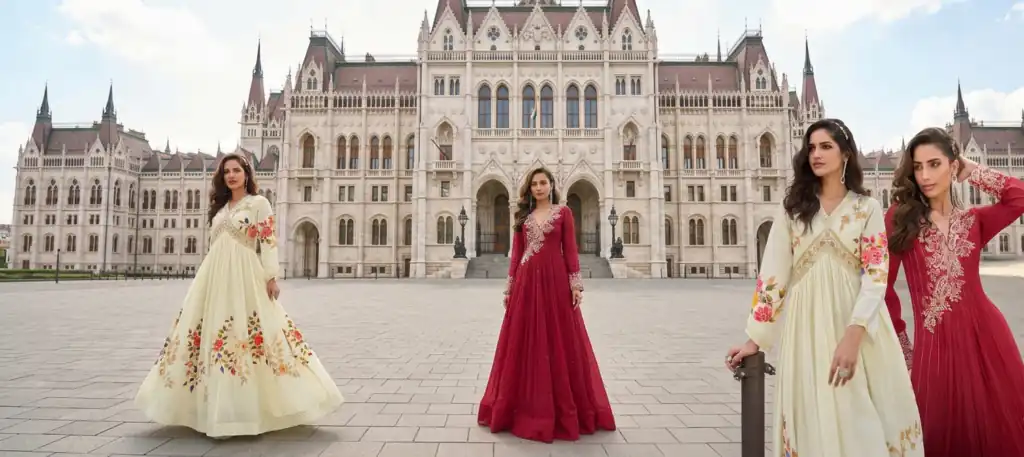
Introduction: The Gown Is Only the Beginning
Picture this.
Two women walk into the same grand ballroom wearing the same ethnic gown. Same silhouette. Same fabric. Same embroidery. Even the same color.
But something is different.
One woman looks beautiful. The other looks extraordinary. One looks like she is wearing an outfit. The other looks like she belongs on a red carpet — like the cameras should be turning, like conversations should be pausing, like the room should be rearranging itself around her presence.
What is the difference?
It is not the gown. They are identical. It is not the makeup, though that plays a role. It is not even confidence, though that is crucial.
It is the accessories.
The right jewelry. The perfect footwear. The intentional bag. The considered hair piece. The strategic layering of elements that transforms a beautiful outfit into a complete, cohesive, unforgettable look.
Accessorizing an ethnic gown is an art form. And like every art form, it has principles, techniques, and rules — some of which exist to be followed, and some of which exist to be broken by the right woman at the right moment.
At IndiaNari, we have dressed women for grand receptions, destination weddings, award functions, formal galas, and every occasion that demands the kind of look that gets remembered. We know what works. We know what does not. And we know the specific magic that happens when an ethnic gown is accessorized with knowledge, intention, and a fearless sense of personal style.
This guide is everything we know about creating your own red-carpet moment — distilled into one comprehensive, actionable resource.
Your gown is ready. Let us build the look around it.
Table of Contents
- Understanding the Ethnic Gown: What Makes It Unique
- The Accessorizing Philosophy: Less vs. More
- Jewelry Masterclass: Choosing Your Statement
- Neckline and Jewelry: The Perfect Pairing Guide
- The Earring Edit: From Statement to Subtle
- Necklace Strategy: Layering, Stacking, and Choosing
- Maang Tikka, Matha Patti, and Head Jewelry
- Bangles, Bracelets, and Arm Jewelry
- The Ring Strategy
- Footwear: The Foundation of Your Red-Carpet Look
- The Bag: Your Final Accessory Statement
- Hair: The Accessory That Frames Everything
- Makeup as an Accessory
- The Dupatta Decision
- The Belt and Kamarband Moment
- Accessorizing by Ethnic Gown Style
- Accessorizing by Occasion
- Color Coordination: Building a Cohesive Accessory Story
- Common Accessorizing Mistakes and How to Fix Them
- IndiaNari’s Red-Carpet Edit
- Final Thoughts and FAQs
1. Understanding the Ethnic Gown: What Makes It Unique
Before we can accessorize brilliantly, we need to understand what we are working with. The ethnic gown is a category unto itself — neither a Western gown nor a traditional Indian outfit, but a hybrid that carries the elegance of both.
What Is an Ethnic Gown?
An ethnic gown combines the floor-length, structured silhouette of a Western-style gown with Indian design elements — embroidery, embellishment, fabric choices, cultural motifs, and traditional craftsmanship. The result is an outfit that is:
- Western in silhouette — long, flowing, fitted or structured
- Indian in soul — rich fabrics, traditional embellishment, cultural identity
- Universal in appeal — appropriate for Indian and international occasions
Types of Ethnic Gowns
Anarkali-Style Ethnic Gown: A floor-length, heavily flared gown based on the Anarkali silhouette. The most traditional ethnic gown style, with roots in Mughal court fashion.
Embellished Fitted Gown: A slim, fitted silhouette in Indian fabrics — silk, brocade, velvet — with traditional embellishment. Combines the elegance of a Western column gown with Indian craftsmanship.
Cape Gown: An ethnic gown with a flowing cape attached at the shoulders. One of the most dramatic and photogenic styles currently trending.
A-Line Ethnic Gown: Fitted at the bodice and flaring gently from the waist in an A-line shape. Universally flattering and elegant.
Mermaid Ethnic Gown: Fitted through the body and flaring dramatically at the knee. High drama, high glamour, perfect for evening receptions.
Layered or Tiered Ethnic Gown: Multiple layers of fabric creating volume and movement. Romantic, dramatic, and spectacularly photogenic.
Cut-Out Ethnic Gown: Contemporary gowns with strategic cut-outs that reveal glimpses of skin. Modern, bold, fashion-forward.
Indo-Western Fusion Gown: The most experimental category — gowns that mix Indian embellishment with Western silhouettes in unexpected, unconventional ways.
Why Accessorizing an Ethnic Gown Is Different
An ethnic gown occupies a unique fashion space that requires a more thoughtful approach to accessorizing than either a purely Indian outfit or a purely Western gown.
The cultural balance: Too Western in your accessories and the ethnic quality of the gown is undermined. Too traditionally Indian and you may over-elaborate a look that already has significant embellishment.
The embellishment consideration: Ethnic gowns are often heavily embellished. Adding accessories requires careful consideration of what the gown already brings visually.
The occasion context: Ethnic gowns are worn to formal events — receptions, award functions, galas, high-profile weddings. The accessory standard is correspondingly high.
The photography consideration: Red-carpet events are photographed extensively. Accessories need to read well in both close-up and full-length shots.
Understanding these unique challenges is the first step to accessorizing your ethnic gown beautifully.
2. The Accessorizing Philosophy: Less vs. More
Before we get into specific accessories, let us establish the philosophy that will guide every decision you make.
The Red-Carpet Principle
Study every genuine red-carpet look — Bollywood, Hollywood, award functions, film festivals. Notice something? The best-dressed women are never the ones wearing the most accessories. They are the ones wearing the right accessories.
Red-carpet dressing is not about maximalism or minimalism. It is about intentionalism. Every single element is chosen deliberately. Nothing is accidental. Nothing is excessive. And nothing is missing.
The Three Levels of Accessorizing
Level 1 — The Minimal Statement
One extraordinary piece and nothing else. A single necklace. A single pair of dramatic earrings. Everything else stripped away. This works when the gown is heavily embellished and the accessories need to step back rather than compete.
Level 2 — The Balanced Look
Two or three significant accessories that work in harmony. Earrings and a necklace. A bracelet and a ring. A bag and shoes. This is the most commonly executed level and the most reliable.
Level 3 — The Full-Impact Look
A complete, layered accessory story where every element is considered. This works for women who understand the principles deeply enough to orchestrate without overcrowding. It is the hardest level to execute correctly and the most spectacular when done right.
The Dominant Accessory Rule
For every look, there should be one dominant accessory — the piece that the eye goes to first, the piece that anchors the aesthetic, the piece that makes the statement.
Everything else in your accessory selection should support this dominant piece rather than compete with it.
If your earrings are the statement, your necklace should be minimal. If your necklace is the statement, your earrings should be understated. If your headpiece is the statement, both your necklace and earrings should step back.
Choose your dominant accessory first. Build everything else around it.
The Gown and Accessory Relationship
The relationship between your gown and your accessories should be one of conversation, not competition.
A heavily embellished gown needs accessories that complement its richness without adding noise. A minimally embellished gown needs accessories that add the missing glamour. A gown with intricate neckwork needs accessories that honor rather than obscure it. A simple-necklined gown needs accessories that bring drama to the area above the embellishment.
Your accessories should complete what the gown started.
3. Jewelry Masterclass: Choosing Your Statement
Jewelry is the heart of accessorizing an ethnic gown. It is the element that most dramatically distinguishes a beautiful look from a red-carpet look. Here is your complete guide.
The Four Jewelry Principles for Ethnic Gowns
Principle 1: Quality Over Quantity
One extraordinary piece of jewelry — real, high-quality, beautifully crafted — will always outperform five mediocre pieces. On a red-carpet occasion, this is not the time to load up. It is the time to choose with precision.
Principle 2: Coordinate Metals
Choose a metal story and stay with it throughout your look. All gold. All silver. All rose gold. Mixing metals can work, but it requires sophisticated styling knowledge. For a red-carpet occasion, cohesive metals create a more polished, intentional appearance.
Principle 3: Consider the Photography
Some jewelry photographs magnificently. Kundan, polki, and stone work catch light in ways that look spectacular in images. Matte, very dark metals can disappear in photographs. When choosing jewelry for a photographed occasion, consider how each piece will read in an image, not just in person.
Principle 4: Match the Cultural Register
Consider the cultural register of your jewelry relative to the gown. A highly contemporary, Western-silhouette ethnic gown may look strange with very heavy, traditional temple jewelry. A classical Anarkali-style gown may look disconnected with ultra-modern geometric jewelry. The cultural register of your jewelry should be in conversation with the cultural register of your gown.
Jewelry Categories for Ethnic Gowns
Traditional Indian Jewelry for Ethnic Gowns:
- Kundan and polki sets
- Jadau jewelry
- Meenakari pieces
- Temple jewelry
- Antique gold and silver work
Contemporary Indian Jewelry for Ethnic Gowns:
- Modern interpretations of traditional forms
- Mixed metal pieces
- Geometric designs in traditional craftsmanship
- Fusion jewelry combining Indian and Western elements
Fine Jewelry for Ethnic Gowns:
- Diamond jewelry
- Pearl sets
- Colored gemstone pieces
- Layered gold or silver chains
4. Neckline and Jewelry: The Perfect Pairing Guide
The relationship between your gown’s neckline and your jewelry is the most critical pairing decision you will make. Getting this right transforms the entire look.
The Complete Neckline-Jewelry Pairing Matrix
Deep V-Neck Gown:
The V-neckline creates a natural focal point — the deep V draws the eye downward in a line from the chin to the lowest point of the neckline. Your jewelry should enhance rather than fight this line.
- Best jewelry: A long pendant necklace that follows the V-line, or layered chains of graduating lengths
- Also works: A choker with a long pendant drop that extends into the V
- Earrings: Can be more dramatic when the neckline is doing the work below — chandelier earrings work beautifully
- Avoid: A wide, flat necklace that cuts horizontally across the V-neckline
Sweetheart Neckline Gown:
The sweetheart neckline frames the décolletage beautifully, creating a curved, feminine focal point.
- Best jewelry: A choker or short princess-length necklace that sits within the curve of the neckline
- Also works: A layered necklace that fills the open neckline space
- Earrings: Statement earrings work particularly well with sweetheart necklines because the neck and collarbone are on full display
- Avoid: Very long necklaces that extend below the neckline, disappearing into the embellishment of the gown
High Neck or Halter Gown:
A high neckline frames the face and creates a clean, sophisticated line. It also — importantly — covers the area where necklaces typically sit.
- Best jewelry: NO necklace. The high neckline replaces the necklace. Your earrings become the primary jewelry statement.
- Also works: A maang tikka or head jewelry that draws attention upward
- Earrings: This is where you go maximum. Long, dramatic chandelier earrings or statement jhumkas are perfect for high-neck gowns
- Avoid: Necklaces layered over high necklines, which look cluttered and unflattering
Off-Shoulder Gown:
The exposed shoulder and collarbone create one of the most jewelry-friendly necklines. The collarbone is displayed beautifully, and the shoulder line creates a natural platform for statement pieces.
- Best jewelry: A bold choker or collar necklace that sits directly on the collarbone
- Also works: A statement necklace with drop elements that frame the décolletage
- Earrings: Can be dramatic — chandeliers or dramatic drops
- Also consider: A shoulder-grazing earring that bridges the gap between earring and bare shoulder
- Avoid: Very long necklaces that hang below the neckline
Boat Neck Gown:
The boat neck is horizontal and sophisticated, creating a wide, elegant frame across the collarbone.
- Best jewelry: A long pendant necklace that breaks the horizontal line and creates vertical interest
- Also works: A simple delicate chain with a significant pendant
- Earrings: Can be dramatic to draw the eye away from the horizontal neckline
- Avoid: Wide, flat necklaces that reinforce the horizontal line
Round Neck Gown:
The classic, versatile neckline that works with almost every jewelry choice.
- Best jewelry: Almost everything works — let the gown’s embellishment and your personal preference guide you
- Particularly effective: A princess-length necklace that fills the space between the neckline and the décolletage
Strapless Gown:
Maximum collarbone and shoulder display creates maximum jewelry opportunity.
- Best jewelry: A statement necklace — bold, significant, attention-commanding
- Also works: A very minimal necklace (or none) and maximum earring drama
- Earrings: Anything from dramatic chandeliers to beautiful studs
- Avoid: No jewelry at all — strapless gowns need jewelry to anchor the look
| Neckline | Best Necklace | Best Earrings | Avoid |
|---|---|---|---|
| Deep V | Long pendant, layered | Chandelier, dramatic drops | Wide horizontal necklaces |
| Sweetheart | Choker, princess length | Statement, chandelier | Long drop necklaces |
| High Neck | None | Maximum drama | Any necklace |
| Halter | None | Chandelier, long drops | Necklaces over the neck |
| Off-Shoulder | Choker, collar | Statement drops | Very long necklaces |
| Boat Neck | Long pendant | Dramatic earrings | Horizontal, wide necklaces |
| Round Neck | Any | Any | Nothing — all options work |
| Strapless | Bold statement necklace | Any style | No jewelry at all |
5. The Earring Edit: From Statement to Subtle
Earrings are often the first jewelry piece the eye finds in a photograph. They frame the face, draw attention to the jawline, and set the overall aesthetic tone of a look. Here is your complete guide.
The Ethnic Gown Earring Hierarchy
Jhumkas: The Indian Classic
The jhumka — that characteristic bell-shaped earring with a dome top and hanging pendant — is one of the most recognized symbols of Indian jewelry. In its contemporary interpretations, it is also one of the most beautiful earring choices for ethnic gowns.
Modern jhumkas for red-carpet looks:
- Chandelier jhumkas: Extended with hanging elements for maximum drama
- Layered jhumkas: Multiple tiers creating a cascading effect
- Contemporary jhumkas: Clean geometric forms in traditional craftsmanship
- Oversized jhumkas: Statement-making dimensions that photograph magnificently
Chandeliers and Statement Drops
For ethnic gowns with high or covered necklines — where no necklace is needed — a magnificent chandelier earring becomes the entire jewelry story. Choose:
- Kundan or polki chandeliers for traditional occasions
- Diamond or crystal chandeliers for more Western-influenced events
- Layered, multi-tier drops for maximum drama
Cuffs and Ear Climbers
A contemporary choice that is gaining significant traction in ethnic fashion styling. Ear cuffs — whether minimal or elaborate — add modern edge to an ethnic gown look without the weight of heavy traditional earrings.
Statement Studs
For very heavily embellished gowns where large earrings would create visual chaos, a pair of extraordinary studs — large diamonds, beautiful kundan work, or significant colored stones — provides the right amount of jewelry without adding noise.
The Earring and Face Shape Guide
| Face Shape | Best Earring Style | Why |
|---|---|---|
| Oval | Any style | Naturally balanced proportions suit all |
| Round | Long drops, chandelier | Adds length, slims visually |
| Square | Curved drops, round jhumkas | Softens angular jaw |
| Heart | Drops that widen at the bottom | Balances wider forehead |
| Oblong/Long | Short drops, wide designs | Adds visual width |
| Diamond | Any drop style | Highlights cheekbones |
6. Necklace Strategy: Layering, Stacking, and Choosing
Single Statement Necklace
The most powerful approach for formal occasions. One extraordinary necklace — beautifully crafted, appropriately scaled, perfectly placed — needs nothing else to support it.
What makes a statement necklace work:
- The scale is appropriate for the neckline and the gown
- The craftsmanship is visible — it needs to be beautiful up close
- The metal and stone work coordinates with the gown’s embellishment
- It sits correctly — not floating away from the body, not pulling down
Layered Necklaces
Multiple chains and pendants at graduating lengths create a modern, editorial approach to neckline jewelry. This works particularly well with:
- Minimal, contemporary ethnic gowns
- Deep V-necklines where the layers follow the V
- Gowns with minimal embellishment that need the accessories to carry the glamour
The layering formula:
- Three chains at most — more creates clutter
- Vary the lengths noticeably — 2-3 inches between each for clear visual separation
- Vary the styles — a delicate chain, a pendant, a statement piece
- Keep the metal coordinated throughout
When No Necklace Is the Right Answer
For gowns with:
- Very high necklines
- Elaborate neckline embroidery or embellishment that would be obscured by a necklace
- A beautiful statement collar or neckline detail designed to be seen
- Very heavy embellishment from neckline to hem
In these cases, skip the necklace entirely and let your earrings and other accessories carry the jewelry story.
7. Maang Tikka, Matha Patti, and Head Jewelry
Head jewelry — the maang tikka, the full matha patti (head chain), the passa (side ornament) — is one of the most distinctly Indian accessory categories. When worn correctly with an ethnic gown, it elevates the look from beautiful to genuinely extraordinary.
The Maang Tikka: When and How
When it works:
- Traditional or semi-traditional ethnic gowns
- Events with cultural significance — wedding functions, religious celebrations, grand ceremonies
- Hairstyles that part in the center or side, allowing the tikka to sit correctly
- Looks where you want to honor Indian tradition explicitly
When to reconsider:
- Very contemporary, Western-silhouette ethnic gowns where the tikka reads as incongruous
- Events with a primarily Western context
- Hairstyles that do not accommodate a tikka gracefully
The most important rule: A maang tikka should sit flat on the forehead, not dangling away from the skin. If it bounces, moves excessively, or does not sit correctly, no amount of style can compensate.
The Matha Patti: Maximum Drama
The matha patti — a more elaborate head ornament that frames the forehead and attaches to both the hair and the ears — is one of the most spectacular pieces of Indian jewelry and creates an extraordinary red-carpet effect when worn correctly.
Best for:
- Bridal or near-bridal occasions
- Heavily embellished traditional ethnic gowns
- Events where maximum traditional glamour is appropriate
- Women with the confidence to carry a significant head ornament
Important: When wearing a matha patti, minimize other jewelry significantly. The matha patti is a dominant statement. Other pieces should step back and let it lead.
The Passa: The Unexpected Statement
The passa — a side ornament that attaches to the hair and drapes to one side of the face — is less common but extraordinarily beautiful when worn well.
Best for: Formal occasions, wedding receptions, events where you want an unexpected jewelry moment
8. Bangles, Bracelets, and Arm Jewelry
The Bangle vs. Bracelet Decision
This is fundamentally a question of cultural register and gown style.
Bangles (traditional, typically a set of multiple) read as more traditionally Indian and work best with:
- Classical ethnic gowns with significant traditional embellishment
- Events with strong cultural context
- Looks that lean more toward traditional Indian aesthetic
Bracelets (single, structured, contemporary) read as more modern and work best with:
- Contemporary ethnic gowns with a more Western silhouette
- Events with mixed cultural context
- Looks that balance Indian and Western aesthetics
Both together: Multiple bangles on one wrist and a single cuff or bracelet on the other can create a beautiful, balanced look that honors both traditional and contemporary aesthetics.
The Arm Jewelry Strategy
For heavily embellished gowns with long sleeves: Skip wrist jewelry entirely. The sleeve embellishment is enough.
For three-quarter sleeve gowns: A small bangle stack or a single bracelet just above the cuff is effective.
For sleeveless or short-sleeve gowns: Your arm is on full display. A statement cuff, a stack of bangles, or a beautiful bracelet can be a significant element of the overall look.
The rule for bangles: If you wear bangles, commit to a quantity that looks intentional — either 2-4 bangles (deliberate, minimal) or a full, dramatic stack (deliberate, maximal). An awkward middle number often looks accidental rather than styled.
The Armlet Trend
The armlet — a piece worn on the upper arm, typically on the right — is a beautiful, unexpected accessory choice for sleeveless or short-sleeve ethnic gowns. It creates visual interest on the arm without the weight of extensive wrist jewelry.
9. The Ring Strategy
Rings are the most personal jewelry category — often tied to relationships, sentiments, and identity beyond pure aesthetics. Here is how to incorporate them into a red-carpet ethnic gown look.
For a Red-Carpet Occasion
Cocktail rings: A large, statement cocktail ring — a colored stone in an elaborate setting, or a significant kundan piece — is a beautiful addition to a formal ethnic gown look. It adds visual interest to the hands in close-up photographs.
Stacked rings: Multiple smaller rings on one or both hands create a contemporary, editorial look that works particularly well with modern, fusion ethnic gowns.
The rule: When wearing elaborate arm or wrist jewelry (heavy bangle stacks, significant cuffs), keep rings minimal. When wrist jewelry is understated, a statement ring can be the focal point.
10. Footwear: The Foundation of Your Red-Carpet Look
Your footwear determines your posture, your comfort, and the line of your gown. It is the foundation on which the entire look rests — quite literally.
The Footwear Philosophy for Ethnic Gowns
Principle 1: The gown’s hemline and your shoe height are inseparable.
Your gown should be hemmed for the exact shoe height you plan to wear. A floor-length ethnic gown hemmed for 4-inch heels will drag on the ground in flats and look unprofessional. A gown hemmed for flats will reveal too much of the foot when you wear heels, breaking the silhouette.
Principle 2: Comfort determines your ability to inhabit the look.
A red-carpet look is not just a static photograph. It is the way you walk, the way you stand, the way you move through the evening. If your feet are in pain, none of this is possible with grace. Choose footwear you can genuinely wear for extended hours.
Principle 3: The shoe needs to be worthy of the occasion.
Your footwear should be as considered as your gown and jewelry. A magnificent ethnic gown with cheap, ill-considered shoes is like a beautiful painting in a broken frame. The shoe matters.
The Footwear Guide for Ethnic Gowns
Embellished Indian Heels
Heavily embellished, Indian-crafted heels — covered in mirror work, zardosi, kundan, or similar embellishment — are the most culturally cohesive choice for ethnic gowns. They bridge the traditional and the contemporary beautifully.
- Best for: Traditional and semi-traditional ethnic gowns
- Most flattering: Block heels for stability, strappy heels for elegance
- Consider: Heel height for hemline matching
Embellished Juttis and Mojaris
Traditional Indian footwear in embellished leather or fabric — for a floor-length ethnic gown, the shoe is largely hidden, making juttis a surprisingly elegant choice.
- Best for: Traditional ethnic gowns, cultural events, occasions where comfort is essential
- Advantage: Extremely comfortable for long events
- Consideration: Ensure the gown’s hemline accounts for the flat height
Metallic Heels
Gold, silver, and metallic heels in a contemporary Western silhouette are a clean, elegant choice for fusion ethnic gowns that combine Indian embellishment with Western styling.
- Best for: Contemporary and fusion ethnic gowns
- Most effective: When the gown has gold or silver elements to coordinate with
- Style note: A metallic heel reads as intentional and sophisticated without being culturally specific
Crystal or Embellished Western Heels
Crystal-embellished stilettos or block heels create a bridge between Indian and Western aesthetic and are particularly effective for evening receptions and formal galas.
- Best for: Evening events, receptions, formal galas
- Most effective: With contemporary ethnic gowns and fusion pieces
Block Heels
The most practical high-heel option for long events. Block heels provide height and elegance without the discomfort and instability of stilettos.
- Best for: All-day or all-evening events involving standing and dancing
- Advantage: Stability allows confident, graceful movement
Stiletto Heels
Maximum height, maximum drama, maximum elegance — and maximum discomfort for long events. Stilettos are best for events where you are primarily seated or standing in one place.
- Best for: Seated events, posed photographs, events where you are not dancing or walking extensively
- Advantage: Creates the most elongated, graceful leg line
Footwear and Color Coordination
| Gown Color | Best Shoe Colors | Why |
|---|---|---|
| Deep jewel tones (navy, emerald, ruby) | Gold, silver, or matching jewel tone | Complements without competing |
| Pastels (lavender, blush, sage) | Nude, metallic, or matching pastel | Light-on-light elegance |
| Black | Gold, silver, or embellished black | Classic contrast |
| White/Ivory | Gold, silver, nude | Maintains the clean palette |
| Gold/Champagne | Gold, nude, crystal | Cohesive metallic story |
| Red/Maroon | Gold, silver, embellished black | Traditional and bold |
11. The Bag: Your Final Accessory Statement
For a red-carpet ethnic gown occasion, the bag is both practical and aesthetic — and the two must be balanced carefully.
The Potli Bag: The Indian Red-Carpet Staple
The potli bag — a small, gathered drawstring bag typically in rich fabric with embellishment — is the most authentically Indian bag choice for ethnic gown occasions.
Why it works:
- Culturally cohesive with Indian ethnic gowns
- Available in heavily embellished versions that are truly beautiful
- The right scale — not too small to look inadequate, not too large to overwhelm
- Can match or complement the gown’s embellishment
What to look for in a red-carpet potli:
- Rich fabric — velvet, silk, brocade
- Significant embellishment — zardosi, stone work, embroidery
- A beautiful metal frame or drawstring closure
- Quality construction
Coordinating a potli with your gown:
- Matching fabric or color for a cohesive look
- Contrasting color for a fashion-forward statement
- Complementary embellishment — if your gown has gold zardosi, a potli with matching gold work creates harmony
The Minaudière and Box Clutch
A structured, hard-cased clutch — whether in a traditional Indian style or a contemporary design — is a sophisticated choice for formal ethnic gown occasions.
Why it works:
- The structured silhouette adds a fashion-forward edge
- Available in heavily embellished Indian versions
- Photographs beautifully in posed shots
- The right scale for formal occasions
The Clutch: Between Potli and Minaudière
A soft, fold-over or envelope clutch in a rich fabric offers a middle ground — more contemporary than a potli, softer than a minaudière.
Best in: Silk, velvet, or heavily embroidered fabric that coordinates with your gown.
The Bag Size Rule
For a red-carpet occasion, smaller is better. A large bag undermines the formality and elegance of an ethnic gown. The ideal bag is large enough to hold your phone, cards, lipstick, and minimal essentials — no more.
If you need more storage, have a trusted companion carry a secondary bag or use coat-check facilities.
The Bag-Gown Relationship
| Gown Style | Best Bag | Why |
|---|---|---|
| Traditional heavily embellished | Potli in matching fabric | Culturally cohesive |
| Contemporary fusion | Structured minaudière | Modern, editorial |
| Pastel, minimal | Embellished potli or clutch | Adds the missing glamour |
| Dramatically embellished | Simple, small clutch | Avoids visual competition |
| Velvet gown | Velvet potli or matching clutch | Coordinated texture story |
12. Hair: The Accessory That Frames Everything
Hair is the accessory that most people forget to consider. But your hairstyle is as much a part of your overall look as your jewelry or footwear. And for a red-carpet occasion, it needs to be as intentional.
The Red-Carpet Hair Principles
Principle 1: Your hair should reveal, not obscure.
If you have a beautiful necklace, your hair should not be falling over it. If your gown has an extraordinary back design, your hair should be up or swept forward. If your earrings are magnificent, your hair should be away from your face. Style your hair to showcase the elements you want seen.
Principle 2: The hairstyle should match the cultural register of the look.
A full traditional Indian bridal bun (juda) works with a traditional ethnic gown. A modern, editorial updo works with a contemporary fusion gown. A romantic half-up style works with a feminine, romantic gown. Mismatching the cultural register of your hair with your gown creates a disconnected look.
Principle 3: Stability matters.
At a formal event, you should not be spending your evening adjusting your hair. Choose a style that stays put through hours of celebration, dancing, and photography. This is where professional styling becomes valuable.
Hairstyles for Ethnic Gown Red-Carpet Looks
The Classic Indian Bun (Juda):
The most versatile and reliably elegant updo for ethnic gowns. A low bun at the nape of the neck is the most formal. A medium bun at the crown is slightly more celebratory. Both expose the neckline for jewelry and create a clean, polished look.
Best paired with: Any traditional or semi-traditional ethnic gown
The Embellished Updo:
An updo decorated with hair accessories — gajra (flower garland), embellished pins, a decorative hair chain, or a delicate tiara — creates a look that is between hairstyle and accessory.
Best paired with: Traditional ethnic gowns, bridal-inspired looks, highly embellished gowns
The Braided Style:
A side braid, a crown braid, or a low braided bun creates a romantic, slightly bohemian look that works beautifully with certain ethnic gown styles.
Best paired with: Romantic, feminine ethnic gowns; destination and outdoor wedding aesthetics
The Hollywood Wave:
Loose, structured waves — either fully down or half-up — create a glamorous, cinematic effect. This works particularly well with contemporary fusion ethnic gowns that have a more Western aesthetic.
Best paired with: Fusion ethnic gowns, evening reception looks, contemporary styles
The Sleek Straight:
Perfectly straight, sleek hair — with a center or side part — is the most modern, fashion-forward hair option for ethnic gowns. It creates a clean, editorial look.
Best paired with: Contemporary and minimal ethnic gowns; looks where you want maximum hair contrast with elaborate embellishment
Hair Accessories for Ethnic Gowns
Gajra (Flower Garland): Fresh or artificial flowers wrapped around a bun or braid. The most Indian hair accessory choice. Works beautifully with traditional gowns and outdoor settings.
Maang Tikka: See Section 7. The maang tikka is attached to the hair parting and hangs to the center of the forehead.
Embellished Hair Pins and Clips: Contemporary and versatile. Can add a hint of sparkle to any updo without overwhelming.
Hair Chains: A delicate chain that drapes across the hair, attaching at multiple points with pins. Bohemian, beautiful, and photographically stunning.
Hair Vines: Flexible, wire-based pieces with floral, crystal, or nature-inspired elements that can be woven through braids or pinned into updos.
13. Makeup as an Accessory
Makeup is not just preparation. For a red-carpet occasion, makeup is an accessory. It completes the look in ways that no piece of jewelry or footwear can.
The Makeup and Ethnic Gown Relationship
The Balance Rule:
Bold jewelry demands more restrained makeup. Restrained jewelry creates space for bolder makeup. The goal is balance — one element is bold, the other supports.
When your necklace is extraordinary, your makeup can be natural — a flushed cheek, a neutral lip, defined eyes. When your jewelry is minimal, your makeup can carry the color and drama — a bold red lip, a smoky eye, a striking brow.
The Photography Consideration:
Red-carpet occasions are photographed. Makeup that looks natural in person can disappear in flash photography. Consider:
- Using slightly more pigment than you would for a casual event
- Ensuring your foundation is not overly dewy (which can look shiny in flash)
- Defining your features more deliberately than you might otherwise
- Wearing lip color that will read in photographs — very pale nudes can disappear
The Red-Carpet Makeup Formulas
Formula 1: The Bold Eye, Nude Lip
Dramatic eye makeup — smoky, defined, dramatic — with a nude or barely-there lip. Powerful, sophisticated, works with heavily jeweled looks.
Formula 2: The Bold Lip, Minimal Eye
A striking lip — red, berry, deep plum — with minimal eye makeup (liner, mascara, defined brow). Classic, effective, photographs magnificently.
Formula 3: The Full Glam
Bold eye, bold lip, contoured face, highlighted cheekbones. The most dramatic option — best for evening receptions, award functions, and occasions where maximum glamour is expected.
Formula 4: The Indian Bridal-Inspired
Kohl-rimmed eyes, a warm, flushed cheek, a traditional red or deep berry lip. Beautiful, culturally cohesive with traditional ethnic gowns.
14. The Dupatta Decision
Not all ethnic gowns include a dupatta. But for those that do — or for gowns where a dupatta can be added — the decision of whether and how to wear it matters enormously.
When the Dupatta Is Essential
- Traditional ethnic gowns where the dupatta is part of the design’s cultural integrity
- Religious or ceremonial events where modesty is appropriate
- Heavily embellished gowns where the dupatta is as much a showpiece as the gown itself
When to Leave It Off
- Contemporary fusion gowns where the dupatta would undermine the modern silhouette
- Events where movement is essential — you cannot dance freely with a dupatta
- Gowns with dramatic back designs that a dupatta would obscure
Dupatta Draping Styles for Ethnic Gowns
The Cape Drape: Pinned at both shoulders, flowing behind. The most dramatic, photogenic, and grand. Best for posed photography and slow, processional walks.
The Single Shoulder: Draped over one shoulder, flowing to the floor on one side. Elegant, manageable, works well for events with movement.
The Waist Pin: Secured at the waist, flowing behind or to the side. Modern, keeps the dupatta in place, allows freedom of movement.
The Pre-Draped: Dupatta pre-pinned into a specific draping that stays in place throughout the event. The most practical choice for active occasions.
15. The Belt and Kamarband Moment
The belt or kamarband — a waist ornament that cinches the gown at the waist — is one of the most transformative accessories available for ethnic gowns.
What a Belt Does for an Ethnic Gown
Creates waist definition: For gowns that flow without defining the waist, a belt creates an hourglass effect that is genuinely striking.
Adds embellishment: A heavily embellished kamarband adds a layer of jewelry to the midsection, creating visual interest in a zone that is often overlooked in accessorizing.
Changes the silhouette: A belt can transform a flowing, unstructured gown into a defined, structured look — two different aesthetics from one garment.
Types of Waist Belts for Ethnic Gowns
The Traditional Kamarband: A jewelry-style belt in gold or silver with embedded stones, often in kundan or polki work. The most traditional and ornate option.
The Embellished Fabric Belt: A belt in the same or contrasting fabric as the gown, with embroidery or embellishment. Creates a cohesive but defined look.
The Metal Link Belt: A contemporary option — a chain or link belt in gold or silver. More modern, works beautifully with fusion gowns.
The Statement Sash: A wide fabric sash tied at the waist. Dramatic, bohemian, and particularly effective with layered or tiered gowns.
16. Accessorizing by Ethnic Gown Style
Different ethnic gown styles call for different accessorizing approaches. Here is your guide.
For the Anarkali-Style Gown
Character: Grand, traditional, sweeping, Mughal-inspired
Jewelry: Kundan or polki set — necklace and matching earrings. A maang tikka. Gold or antique silver bangles.
Footwear: Embellished juttis or embroidered block heels
Bag: Embroidered or embellished potli
Hair: Classic updo with gajra or embellished pins
Dupatta: Worn traditionally or in a cape drape for maximum impact
For the Contemporary Fusion Gown
Character: Modern, fashion-forward, Western silhouette with Indian elements
Jewelry: Statement earrings. A contemporary pendant necklace or layered chains. A modern cuff or bracelet.
Footwear: Metallic heels or embellished contemporary heels
Bag: Structured minaudière or contemporary clutch
Hair: Modern updo or sleek straight
Dupatta: Optional — often better without
For the Cape Gown
Character: Dramatic, editorial, movement-focused
Jewelry: Minimal. The cape IS the statement. Add significant earrings and keep the necklace understated or skip entirely.
Footwear: Your best heels — the cape will frame your legs and footwear more than most gown styles
Bag: Minimal, small clutch
Hair: Updo or sleek — do not compete with the drama of the cape
For the Mermaid Ethnic Gown
Character: Maximum glamour, body-celebrating, evening-specific
Jewelry: Full glamour. This gown demands serious jewelry. A significant necklace, statement earrings, dramatic wrist jewelry.
Footwear: Your highest, most dramatic heels — the mermaid silhouette is enhanced by height
Bag: Embellished potli or statement clutch
Hair: Full updo or glamorous Hollywood waves
For the Minimal, Embellishment-Light Gown
Character: Understated, modern, fabric-forward
Jewelry: This is where your accessories carry the glamour. Choose your most significant jewelry. Let the accessories do the work the embellishment is not doing.
Footwear: Significantly embellished — your shoes need to add the missing glamour
Bag: A beautiful, embellished potli or significant clutch
17. Accessorizing by Occasion
Wedding Reception
The occasion: Evening, grand, highly photographed
Accessory level: Maximum. This is the occasion for your best jewelry, your most beautiful shoes, your most spectacular bag.
Key accessories: Statement necklace or chandelier earrings. Full bangle set or significant cuff. Heavily embellished footwear. Beautiful potli or minaudière.
Award Function or Formal Gala
The occasion: Formal, professional, international context
Accessory level: Significant but considered. The context is more Western than a wedding reception.
Key accessories: One statement jewelry piece. Modern, elegant footwear. A structured clutch. Hair that is polished and professional.
Destination Wedding
The occasion: Often outdoor or semi-outdoor, beautiful natural settings, casual-formal hybrid
Accessory level: Celebratory but practical. Beauty that survives outdoor conditions.
Key accessories: Lighter jewelry that does not weigh you down. Stable, practical footwear that works on grass and uneven surfaces. A lightweight potli or small crossbody.
Evening Cocktail Function
The occasion: Semi-formal to formal, social, sophisticated
Accessory level: Fashion-forward and stylish. This is your chance to experiment.
Key accessories: A fashion-forward statement earring. Modern jewelry. A beautiful clutch. Heels that make an impact.
18. Color Coordination: Building a Cohesive Accessory Story
The colors of your accessories must work harmoniously with your gown and with each other. Here is a simple framework.
The Three-Color Rule
In any accessorized look, work with a maximum of three colors:
- The gown color (your anchor)
- Your metal color (gold or silver — choose one)
- One accent color (from your jewelry or shoes)
Everything should fall within this three-color framework.
Metal and Gown Color Guide
| Gown Color | Best Metal | Why |
|---|---|---|
| Red/Maroon | Gold | Warm metal enhances warm color |
| Emerald/Deep Green | Gold | Warm metal enhances depth |
| Navy/Sapphire Blue | Silver or gold | Both work — silver for cool, gold for traditional |
| Black | Gold or silver | Both work — your preference |
| Ivory/White | Gold or pearl | Warm tones enhance light neutrals |
| Lavender/Purple | Silver or white gold | Cool metals complement cool tones |
| Blush/Pink | Rose gold or pearl | Warm-neutral metals complement warm pinks |
| Champagne/Gold | Gold | Tonal coordination creates luxury |
19. Common Accessorizing Mistakes and How to Fix Them
Mistake 1: Wearing Too Many Statement Pieces
The mistake: A statement necklace, chandelier earrings, heavy bangles, a bold ring, a maang tikka, and a heavily embellished bag — all at once.
Why it fails: When everything is a statement, nothing is a statement. The eye does not know where to go and the overall look is exhausting rather than impressive.
The fix: Choose ONE dominant accessory. Build everything else around it in support.
Mistake 2: Mismatched Metals
The mistake: Gold earrings with silver bangles, gold shoes with a silver clutch, mixed metals throughout.
Why it fails: Metal inconsistency reads as accidental and unpolished.
The fix: Choose your metal story at the beginning and commit to it throughout.
Mistake 3: Ignoring Scale
The mistake: Tiny, delicate jewelry on a heavily embellished gown that swamps it completely. Or oversized, heavy jewelry on a minimal gown that overwhelms it.
Why it fails: Scale mismatch creates visual imbalance and undermines both the outfit and the accessories.
The fix: Match the scale of your accessories to the scale of your gown’s embellishment. Heavy gown — significant accessories. Minimal gown — more elaborate accessories.
Mistake 4: Practical Failure
The mistake: Choosing heels too high to walk in, bangles that clank during speeches, a bag too small for your phone, or a dupatta that requires constant management.
Why it fails: Accessories that undermine your ability to function at the event undermine the entire look.
The fix: Test everything before the event. Walk in your shoes. Sit in your gown. Wear your jewelry for an hour at home.
Mistake 5: Forgetting the Back View
The mistake: Accessorizing perfectly for the front view while completely ignoring the back.
Why it fails: Photographs are taken from every angle. And making an entrance means being watched from behind as you walk away.
The fix: Check your look in a mirror from behind. Ensure the back of your hair, the back of your gown, and the accessories visible from behind are as considered as the front.
20. IndiaNari’s Red-Carpet Edit
At IndiaNari, our ethnic gown collection has been curated with one purpose: to give every woman access to looks that belong on a red carpet, regardless of her occasion.
Our Red-Carpet Ethnic Gown Collection
The Grand Entrance Collection: Floor-length, heavily embellished ethnic gowns in silk, velvet, and net. For women who want to make the room pause.
The Contemporary Fusion Edit: Modern silhouettes with Indian embellishment for women who live between traditions.
The Cape Gown Selection: Our most dramatic and photographically spectacular category.
The Minimal Luxury Range: Understated ethnic gowns where fabric quality and cut do the work — for women who believe that elegance never shouts.
The Seasonal Specials: New additions with every season that reflect current color and design trends.
Explore IndiaNari’s Complete Ethnic Gown Collection — Curated for red-carpet moments, styled for real women. New arrivals weekly. Free shipping above Rs. 999. Expert styling guidance available.
21. Final Thoughts: Creating Your Own Red Carpet
Here is the truth that every red-carpet stylist knows and rarely shares:
The red carpet does not create extraordinary women. Extraordinary women create the red carpet.
The cameras do not find you because you are wearing the most expensive gown or the most elaborate jewelry. They find you because something about how you carry yourself — how you wear what you have chosen, how you inhabit the moment, how you know yourself deeply enough to dress with intention — is genuinely compelling.
Every decision we have walked through in this guide is ultimately in service of that one goal: helping you know yourself well enough to dress with intention. To know which necklace works with which neckline. To know how much is too much. To know when to let the gown lead and when to let the accessories speak. To know which color makes your skin glow and which shoe height lets you walk with grace.
That knowledge is what creates a red-carpet look. Not the budget. Not the brand. The knowledge.
And now you have it.
Walk into your next grand occasion with your ethnic gown, your considered accessories, your intentional makeup, and your entirely earned confidence. Look in the mirror and see what we already know: you were always ready for this moment.
IndiaNari is here to make sure your outfit is ready too.
Frequently Asked Questions
Q1: How do I choose between gold and silver jewelry for an ethnic gown?
A: Base your decision on the gown’s embellishment and your skin tone. Gold is generally more traditional and works beautifully with warm colors like red, green, and earthy tones. Silver works beautifully with cool colors like blue, purple, and black. When in doubt, gold is the more universally safe choice for Indian ethnic wear.
Q2: Can I mix traditional and contemporary accessories with an ethnic gown?
A: Yes, with care. The key is balance — if your gown is very traditional, contemporary accessories can modernize it effectively. If your gown is very contemporary, traditional accessories can ground it culturally. Avoid equal measures of both, which can create a disconnected look.
Q3: What accessories work best for a heavily embellished ethnic gown?
A: Choose minimal accessories and let the gown lead. A pair of beautiful earrings, simple footwear that does not compete, and a coordinated potli are typically sufficient. Resist the temptation to add heavy jewelry to an already elaborate gown.
Q4: Is it appropriate to wear a maang tikka with an ethnic gown to a non-Indian event?
A: Absolutely. A maang tikka is a beautiful piece of Indian jewelry and is appropriate whenever it complements your outfit and feels authentic to your expression of identity. Cultural appreciation through jewelry is entirely welcome.
Q5: How do I keep my accessories secure throughout a long event?
A: Use jewelry adhesive for pieces prone to shifting. Secure your dupatta with safety pins before the event. Test your footwear for comfort before the event day. Pre-drape or pre-pin your dupatta. Ensure all jewelry clasps are secure and functioning.
Q6: What bag is most appropriate for a formal ethnic gown occasion?
A: A beautifully embellished potli or a structured minaudière in a coordinating color. The bag should be small, elegant, and clearly considered — not a casual or everyday bag pressed into service.
Q7: Can I wear Western jewelry with an ethnic gown?
A: Yes, particularly with contemporary and fusion ethnic gowns. Diamond jewelry, pearl sets, and modern gold or silver pieces work beautifully with ethnic gowns that have a more Western silhouette. With very traditional gowns, traditional Indian jewelry typically creates more cohesive looks.
Q8: How do I coordinate accessories when wearing a patterned or printed ethnic gown?
A: Pull one color from the print and coordinate your accessories around that color. Keep jewelry minimal — let the print do the work. Choose solid-colored shoes and bag in one of the gown’s colors.
Q9: What is the most important accessory for an ethnic gown red-carpet look?
A: Confidence, followed closely by footwear. The way you walk, stand, and inhabit your look is the most transformative accessory available. And your footwear determines your physical ability to carry yourself with grace — making it the most important tangible accessory.
Q10: Does IndiaNari offer styling consultation for accessorizing ethnic gowns?
A: Yes. Our customer support and styling team provides personalized accessorizing guidance for every purchase. Contact us through our website or reach out via social media. We are here to help you create your complete red-carpet look.
Connect with IndiaNari
Website: www.indianari.com
Instagram: @IndiaNari
Facebook: IndiaNari
Pinterest: IndiaNari Style
Subscribe to our newsletter for weekly styling guides, new collection alerts, and exclusive member-only offers delivered directly to your inbox.
Did this guide help you plan your red-carpet ethnic gown look? Share it with the women in your life who have a grand occasion coming up. And tell us in the comments — what is your favorite accessory for completing an ethnic gown look? We read every comment and love hearing from our IndiaNari community.
Tags: #EthnicGown #RedCarpetLook #IndianEthnicWear #IndiaNari #EthnicGownAccessories #IndianFashion #EthnicStyle #JewelryGuide #IndianJewelry #EthnicWear #FormalWear #WeddingGown #AccessorizingGuide #IndianRedCarpet #EthnicFashion #GownStyling #IndianWomenFashion #EthnicGownStyle #AccessoryGuide #FashionGuide