
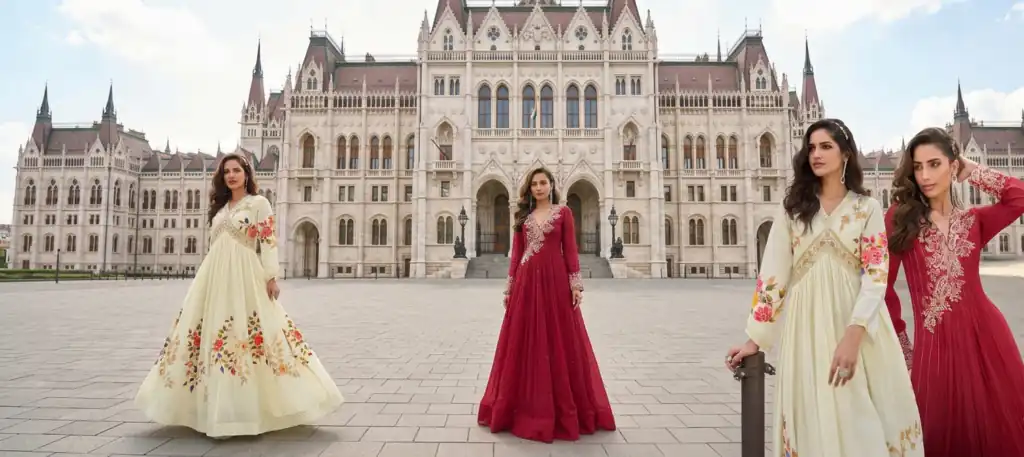
Introduction: When Two Worlds Create Something Extraordinary
There is a moment in fashion history that defined a generation of Indian women.
It was not a single runway show. It was not one celebrity’s outfit. It was a collective, gradual, deeply personal realization that happened across living rooms, college campuses, wedding halls, and Instagram feeds simultaneously.
The realization was this: we do not have to choose.
For years, the Indian woman was presented with a binary. Traditional or modern. Ethnic or contemporary. Saree or dress. Indian or Western. As if her identity — ancient and evolving, deeply rooted and globally connected — could be neatly filed into one column or the other.
And then came the Indo-Western gown.
Not a compromise. Not a halfway measure. Not tradition apologizing for existing in a modern world. But a bold, confident, glorious synthesis — an outfit that takes the best of Indian craftsmanship, heritage, and identity, and fuses it with the silhouettes, sensibilities, and freedom of contemporary global fashion.
The result is something that belongs entirely to the modern Indian woman. Something that tells her complete story — where she comes from and where she is going, what she carries and what she creates, who she has always been and who she is becoming.
The Indo-Western gown is not a trend. It is not a moment. It is a movement. And if you are not already part of it, this guide is your invitation.
At IndiaNari, we have watched this movement grow from a niche fashion experiment to the dominant force in modern Indian ethnic wear. We have curated collections, studied the evolution, listened to the women who wear these gowns, and understood what makes this category so uniquely, powerfully resonant.
This is everything we know about why Indo-Western gowns are the ultimate vibe — and how to wear them in a way that is entirely, unmistakably yours.
Table of Contents
- Understanding the Indo-Western Gown: A Cultural Revolution
- The DNA of an Indo-Western Gown: What Makes It Unique
- Why Indo-Western Gowns Are Having Their Biggest Moment
- The Style Spectrum: Types of Indo-Western Gowns
- Trending Indo-Western Gown Designs for 2024-2025
- Trending Colors and Fabrics for Indo-Western Gowns
- The Body Type Guide: Finding Your Perfect Indo-Western Silhouette
- Occasion Guide: Which Indo-Western Gown for Which Event
- Styling Your Indo-Western Gown: The Complete Guide
- Accessorizing the Indo-Western Way
- Hair and Makeup for Indo-Western Gowns
- The Celebrity Influence: Who Is Wearing What
- Indo-Western Gowns vs. Traditional Ethnic Wear: Understanding the Balance
- Building an Indo-Western Wardrobe
- Caring for Your Indo-Western Gown
- Common Indo-Western Styling Mistakes
- IndiaNari’s Indo-Western Gown Collection
- Final Thoughts and FAQs
1. Understanding the Indo-Western Gown: A Cultural Revolution
To understand why the Indo-Western gown resonates so deeply, we need to understand the cultural moment that created the conditions for its rise.
The Identity Equation
The modern Indian woman is simultaneously:
- A woman with deep roots in Indian tradition, culture, and heritage
- A citizen of a globalized, connected world with access to international fashion, media, and culture
- An individual with a unique personal aesthetic that may not fit neatly into either “traditional” or “Western” boxes
- A professional, a creative, a student, a mother, a traveler — identities that exist across cultural contexts
Traditional Indian ethnic wear sometimes felt limiting for certain contexts and events. Western fashion sometimes felt disconnected from her cultural identity. And the space between the two was where millions of Indian women were living.
The Indo-Western gown filled that space.
What Changed Everything
Several forces converged to create the Indo-Western gown phenomenon:
Bollywood’s evolution: When Bollywood leading ladies began appearing in Indo-Western fusion outfits for film promotions, airport appearances, and international events, the message was clear — this was not a niche experiment. It was the new mainstream.
Social media democratization: Instagram and Pinterest gave ordinary women access to extraordinary styling ideas. They could see how Indo-Western gowns were being worn globally and immediately begin experimenting with their own versions.
Designer innovation: Indian fashion designers began taking the fusion concept seriously at a high level — creating Indo-Western gowns with the same craftsmanship and intentionality that had always characterized their traditional work.
The globalization of Indian weddings: As Indian weddings became increasingly international events — destination weddings, diaspora celebrations, multicultural marriages — the need for outfits that bridged cultures became urgent.
The rise of conscious fashion: As women began thinking more carefully about what they wore and why, the deliberate choice to wear Indian craft in contemporary silhouettes became a statement of cultural pride.
The Cultural Significance
The Indo-Western gown is not just a fashion category. It is a cultural statement.
Wearing an Indo-Western gown says: I know where I come from and I am proud of it. I know where I am going and I am ready for it. I do not see these two things as contradictions — I see them as the complete picture of who I am.
That is not just fashion. That is identity. That is confidence. That is the future.
2. The DNA of an Indo-Western Gown: What Makes It Unique
Not every fusion outfit qualifies as a true Indo-Western gown. Understanding what genuinely defines this category helps you recognize it, appreciate it, and choose it more effectively.
The Indian Elements
A true Indo-Western gown always carries identifiable Indian elements — not as decoration, but as integral, essential components of the design.
Indian Embellishment: Zardosi, resham embroidery, chikankari, mirror work, kantha, block printing — the embellishment techniques that are uniquely Indian and represent centuries of craftsmanship.
Indian Fabrics: Silk, chanderi, Banarasi, khadi, tussar, organza with Indian finishing — fabrics that are either native to India or have been woven into Indian fashion tradition.
Indian Motifs: Paisley, floral Mughal patterns, geometric jaali work, nature-inspired Indian design language, traditional Indian architectural motifs.
Indian Color Philosophy: The rich, saturated color stories of Indian fashion — jewel tones, festival brights, traditional combinations — applied to contemporary silhouettes.
Indian Craftsmanship: The distinctive quality of Indian handwork — the variations, the human touch, the storytelling through thread and needle — that distinguishes handcrafted Indian embellishment from machine production.
The Western Elements
Silhouette: A-line gowns, column gowns, mermaid gowns, wrap dresses, shirt dresses — the clean, body-conscious, or dramatically shaped silhouettes of Western formal and semi-formal wear.
Construction Techniques: Structured bodices, boning, invisible zippers, Western seaming techniques that create precise, tailored fits.
Necklines: Off-shoulder, sweetheart, plunging V, halter, one-shoulder — necklines drawn from Western fashion vocabulary.
Sleeve Styles: Cold shoulder, puff sleeves, bell sleeves, spaghetti straps — sleeve treatments from Western fashion tradition.
Length and Proportions: Floor-length gown proportions, thigh-high slits, asymmetric hemlines — length treatments from Western formal wear.
The Fusion Magic
The magic of the Indo-Western gown is what happens when these elements are combined with genuine intentionality — not randomly mixed, but thoughtfully synthesized.
When it works: Indian embroidery on a Western silhouette creates depth and cultural richness. Western structure on Indian fabric creates precise fit with luxurious material. Indian color philosophy applied to contemporary shapes creates visual impact with familiar vocabulary.
When it fails: When the fusion feels like costume rather than clothing. When Indian elements are applied superficially — as decoration on an otherwise entirely Western piece — without genuine cultural integration. When the two halves do not speak to each other aesthetically.
The difference: In a true Indo-Western gown, you cannot easily separate the Indian from the Western. They are integrated at a level where removing either would destroy the whole. That integration is the mark of genuine fusion design.
3. Why Indo-Western Gowns Are Having Their Biggest Moment
The Indo-Western gown has existed as a concept for decades. But right now, in 2024-2025, it is experiencing a moment unlike any in its history. Here is why.
The Cultural Pride Renaissance
Across India and the global Indian diaspora, there is a powerful resurgence of cultural pride. Young Indian women who might once have gravitated exclusively toward Western fashion are now actively seeking ways to incorporate their heritage into their personal style.
The Indo-Western gown offers exactly this — a way to wear Indian craftsmanship, motifs, and fabrics without feeling culturally confined. It is the fashion equivalent of speaking English with confidence while dreaming in your mother tongue.
This is cultural pride with contemporary fluency. And it is resonating everywhere.
The Global Indian Woman’s Moment
The Indian woman on the global stage has never been more visible, more influential, or more celebrated. From Priyanka Chopra Jonas to Deepika Padukone, from Mindy Kaling to the countless Indian women leading industries, institutions, and conversations across the world — the Indian woman has arrived in global consciousness.
Her fashion choices are part of that arrival. The Indo-Western gown allows her to show up on any global stage — red carpet, boardroom, wedding, international event — wearing something that is entirely, authentically, proudly Indian in its craftsmanship while being entirely, comfortably appropriate for the global context.
She does not have to choose between her two worlds. Her gown says she lives in both.
The Social Media Aesthetic
Visually, the Indo-Western gown is extraordinary on camera.
The combination of intricate Indian embellishment with clean, contemporary silhouettes creates images that are simultaneously detailed and architectural. The fusion of cultural specificity with universal elegance makes them interesting to global audiences who might not otherwise engage with purely traditional Indian fashion.
On Instagram, Pinterest, and increasingly on YouTube and TikTok, Indo-Western gown styling content performs spectacularly — drawing engagement from Indian audiences who see themselves represented and from global audiences who are discovering Indian fashion through this contemporary lens.
The Designer Investment
When India’s most celebrated fashion designers began investing seriously in the Indo-Western gown category, it signaled a fundamental shift in how the fashion industry viewed fusion dressing.
Designers like Tarun Tahiliani, Manish Malhotra, Anita Dongre, and Sabyasachi began creating Indo-Western pieces that received the same level of craftsmanship, attention, and narrative as their traditional collections. This designer endorsement elevated the category from casual fusion experiment to serious fashion statement.
The Occasion Gap
Indian social life in 2024 includes a growing number of occasions that do not fit cleanly into either traditional Indian fashion or Western formal wear. Destination weddings. International corporate events. Multicultural celebrations. Cross-cultural social occasions.
For all of these events, the Indo-Western gown is the perfect solution — formal enough for grand occasions, contemporary enough for international contexts, culturally specific enough to honor Indian identity.
The occasion gap created the demand. The designers filled it. And the women claimed it as their own.
4. The Style Spectrum: Types of Indo-Western Gowns
The Indo-Western gown is not a single style — it is a spectrum. Understanding the range helps you find the specific expression that resonates with your personal aesthetic.
The Embroidered Western Silhouette Gown
The most straightforward fusion: a Western gown silhouette — A-line, column, mermaid — executed in Indian fabric with Indian embellishment.
Characteristics:
- Clean Western cut — structured bodice, defined waist, Western hemline
- Indian fabric — silk, chanderi, organza, brocade
- Indian embellishment — zardosi, resham embroidery, chikankari, mirror work
- The Indian-ness is entirely in the fabric and embellishment
The vibe: Sophisticated, globally appropriate, understated fusion
Best for: Women who love the structure of Western gowns but want the richness of Indian craftsmanship. Occasions where a strong cultural statement is not the priority but Indian identity is still honored.
The Traditional Silhouette in Contemporary Execution
The inverse: a traditional Indian silhouette — Anarkali, kurta, lehenga-inspired — executed with contemporary design choices.
Characteristics:
- Traditional Indian silhouette — the Anarkali flare, the kurta length
- Contemporary details — modern necklines, cut-outs, Western fabric, minimal embellishment
- The Western-ness is in the details and execution
The vibe: Heritage-rooted with a modern edge
Best for: Women who love traditional Indian silhouettes but want to modernize their expression. Cultural events where the traditional connection matters.
The Cape Gown
One of the most dramatically beautiful and widely worn Indo-Western styles. A fitted gown with a flowing cape — often in organza, net, or sheer fabric — attached at the shoulders.
Characteristics:
- Fitted, structured gown body
- Dramatic flowing cape that creates movement and photography magic
- Often features Indian embellishment on the cape or gown body
- Creates a dual-layer effect that is distinctly Indian-influenced while being thoroughly contemporary
The vibe: Cinematic, grand, red-carpet ready
Best for: Grand occasions — receptions, award functions, formal galas. Women who want maximum visual impact. Photography-heavy events.
The Draped Gown
A gown that incorporates saree-like draping elements into its construction — a draped shoulder, a flowing panel that echoes the saree pallu, a pre-stitched drape that creates the visual of a saree without the complexity of draping one.
Characteristics:
- Saree-influenced draping as a design element
- Often combines a fitted lower body with a draped upper portion
- The draping is typically pre-stitched for easy wearing
- Feels like wearing a saree with the convenience of a gown
The vibe: Elegant, graceful, heritage-connected with practical modern design
Best for: Women who love the saree aesthetic but prefer the convenience of a gown. Traditional events where a connection to saree culture feels appropriate.
The Shirt Dress and Kurta Gown
A long dress that draws its design from the traditional kurta or Indian shirt — extended to floor-length, in Indian fabrics, with Indian embellishment or prints.
Characteristics:
- Kurta-inspired design — placket, collar, traditional construction details
- Floor-length or midi length
- Indian fabric and prints
- Can be belted or worn flowing
The vibe: Relaxed, contemporary, intellectual, artisanal
Best for: Casual events, daytime occasions, cultural gatherings, women who prefer understated elegance over grand statements.
The Cut-Out Gown
A contemporary ethnic gown featuring strategic cut-outs — at the waist, back, shoulders, or sides — that create a modern, fashion-forward effect while maintaining Indian embellishment.
Characteristics:
- Indian embellishment and fabric
- Western-influenced cut-outs creating visual interest
- More modern and fashion-forward than classic fusion
- Higher on the contemporary scale of the fusion spectrum
The vibe: Bold, fashion-forward, Instagram-worthy, young energy
Best for: Fashion-forward women, cocktail events, contemporary weddings, women who want to make a strong style statement.
The High-Low and Asymmetric Gown
A gown with asymmetric hemlines — shorter in the front, longer in the back, or deliberately uneven. Creates movement, visual interest, and a fashion-forward effect.
Characteristics:
- Asymmetric or high-low hemline
- Indian embellishment or fabric
- Contemporary construction
- Dynamic, interesting silhouette
The vibe: Playful, modern, editorial, fashion-conscious
Best for: Sangeet, cocktail events, contemporary wedding functions, women who love unexpected design details.
The Jacket Gown
A structured jacket — often heavily embellished — worn over an inner gown or dress. The jacket can be long (floor-length) or short (waist or hip-length).
Characteristics:
- A separate jacket layer over an inner garment
- Jacket is typically the main design statement
- Creates a layered, structured look
- The jacket can be removed for a completely different look
The vibe: Structured, powerful, fashion-forward, Bollywood-inspired
Best for: Winter events, receptions, formal occasions, women who want versatility (two looks in one)
5. Trending Indo-Western Gown Designs for 2024-2025
The Indo-Western gown landscape is constantly evolving. Here are the specific designs and details that are trending right now.
Trend 1: The Organza Moment
Organza — that beautiful, slightly stiff, sheer fabric — has become the defining fabric of the Indo-Western gown trend. Its ability to hold dramatic shapes while remaining light, its sheer quality that creates layering possibilities, and its spectacular behavior in photographs have made it the most desired fabric in the category.
How organza is being used:
- Full organza gowns: The entire gown in layered organza, creating a dramatic, voluminous silhouette
- Organza overlay: An organza layer over a more opaque inner gown, creating depth and dimension
- Organza capes: The cape portion in organza while the gown body is in a more substantial fabric
- Organza ruffles: Ruffled accents in organza on an otherwise structured gown
Why it is trending: Organza photographs extraordinarily well. It creates the movement and float that makes video content spectacular. It layers beautifully. And in a world where fashion is increasingly consumed through screens, organza’s photogenic quality is genuinely valuable.
Trend 2: Botanical and Floral Embroidery
Organic, nature-inspired embroidery — botanicals, florals, vines, leaves — rendered in Indian embroidery techniques on contemporary gown silhouettes is one of the most significant design trends of 2024-2025.
The specific embroidery styles trending:
- Resham floral embroidery: Colorful silk thread florals scattered across the gown body
- Tonal floral embroidery: Same-color thread work on matching fabric for a subtle, sophisticated effect
- Three-dimensional floral work: Raised embroidery creating actual texture and dimension
- Botanical print with embroidery overlay: Printed botanicals enhanced with hand embroidery details
Why it is trending: The organic, natural quality of botanical embroidery feels simultaneously traditional (Indian embroidery has always drawn from nature) and contemporary (the wellness and sustainability aesthetic of the moment). It photographs beautifully and feels timeless rather than trend-specific.
Trend 3: The Dramatic Sleeve Statement
Sleeves have become the focal point of Indo-Western gown design — and the more dramatic, the better.
Trending sleeve styles:
- Bishop sleeves: Full, voluminous sleeves gathered at the wrist
- Bell sleeves: Sleeves that flare dramatically from the elbow
- Puff sleeves: Gathered at the shoulder, tapering to fitted
- Sheer sleeves: Full-length sleeves in organza or net, often heavily embellished
- Detachable sleeves: Sleeves that can be removed to create a different look
Why it is trending: Statement sleeves allow maximum design impact with minimum cost — the sleeve is a relatively small portion of the garment but carries disproportionate visual weight. In photographs, dramatic sleeves create instantly recognizable silhouettes.
Trend 4: Corset Bodices with Indian Embellishment
The structured, boned corset bodice has moved from Western lingerie and eveningwear into the Indo-Western gown space — with spectacular results.
How it appears:
- Traditional Indian embellishment (zardosi, kundan work) on a corset-structured bodice
- Corset-style boning creating a defined, structured hourglass at the waist
- Lace-up back details combined with Indian fabric and embellishment
- The corset bodice contrasted with a dramatically flowing Indian skirt or cape
Why it is trending: The corset bodice is simultaneously classic and contemporary, structured and feminine, Western in origin and completely beautiful with Indian embellishment. It creates a waist definition that is flattering on virtually every body type.
Trend 5: The Minimalist Luxury Gown
In direct contrast to the heavily embellished end of the spectrum, there is a significant trend toward minimalist Indo-Western gowns — clean silhouettes, quality fabrics, minimal embellishment, and extraordinary construction.
Characteristics:
- High-quality Indian fabrics (raw silk, fine chanderi, quality crepe)
- Minimal or completely absent embellishment
- Perfect construction and fit as the design statement
- Understated color palette — ivory, sage, dusty rose, slate grey
Why it is trending: The “quiet luxury” aesthetic that is dominating global fashion has found its Indo-Western expression. Women who want to communicate sophistication without ostentation are drawn to this approach.
Trend 6: Heritage Textile Gowns
Using heritage Indian textiles — Banarasi silk, Jamdani, Chanderi, Ikat, Ajrakh — in contemporary gown silhouettes creates pieces that are simultaneously fashion-forward and deeply culturally significant.
The message it sends: This woman knows her culture. She is proud of it. And she refuses to confine it to traditional forms — she will wear her heritage on her own terms.
Why it is trending: As the sustainable fashion movement grows, heritage textiles — handwoven, naturally dyed, artisanal — represent the opposite of fast fashion. Wearing them is simultaneously a fashion statement and an ethical choice.
6. Trending Colors and Fabrics for Indo-Western Gowns
The 2024-2025 Indo-Western Color Palette
Sage and Olive Green: The Earthy Power
Sage green in its various iterations — from very light celadon to deeper olive — has become the defining color of contemporary Indo-Western fashion. It feels simultaneously traditional (green has deep significance in Indian culture) and completely current.
- Pairs beautifully with gold embellishment
- Flatters warm and neutral skin tones magnificently
- Photographs with beautiful natural warmth
- Works for both daytime and evening occasions
Ivory and Off-White: The Quiet Statement
The intentional choice of ivory — particularly in heritage Indian textiles — has become a powerful fashion statement. It communicates confidence, taste, and a sophisticated understanding of fashion that does not need color to make an impact.
- Works across all skin tones when chosen in the right undertone
- Forces the focus onto fabric quality and construction
- Creates a canvas for subtle, tonal embellishment
- Photographs with ethereal beauty in natural light
Dusty Rose and Antique Pink: The Warm Romantic
Not bright pink, not pale blush — the muted, warm, slightly dusty version of rose that has dominated global fashion is finding its most beautiful expression in Indo-Western gowns.
- Flatters warm and neutral skin tones
- Pairs beautifully with rose gold and pearl jewelry
- Feels romantic and feminine without being girlish
- Works across all occasions from daytime functions to evening receptions
Midnight and Ink Blue: The Dramatic Depth
Deep, saturated blues — midnight, navy, ink, sapphire — create one of the most powerful Indo-Western gown aesthetics. The depth of the color makes any embellishment pop dramatically.
- Universally flattering across all skin tones
- Works spectacularly in artificial evening lighting
- Creates instant formality and sophistication
- Pairs beautifully with both gold and silver
Rust and Terracotta: The Contemporary Heritage
Earthy, warm, deeply Indian in its cultural associations, rust and terracotta are experiencing a massive moment in Indo-Western fashion. They feel contemporary and heritage-rooted simultaneously.
- Exceptional on warm and deep skin tones
- Photographs beautifully in natural, golden hour light
- Pairs magnificently with antique gold embellishment
- Creates an artisanal, craft-conscious aesthetic
Charcoal and Slate: The Unconventional Neutral
Moving beyond black as the “safe” neutral choice, charcoal and slate are being embraced as sophisticated, unexpected alternatives in Indo-Western gowns.
- Works across all skin tones
- Creates a graphic, architectural backdrop for embellishment
- Photographs with interesting depth and texture
- Feels more fashion-forward than straight black
The Fabric Guide for Indo-Western Gowns
| Fabric | Fusion Level | Best For | Photography Quality |
|---|---|---|---|
| Organza | High contemporary | Capes, overlays, dramatic silhouettes | Extraordinary — sheer and floating |
| Raw silk | Balanced fusion | Heritage textile gowns, understated luxury | Excellent — rich texture |
| Chanderi | Balanced fusion | Daytime gowns, understated elegance | Very good — subtle sheen |
| Georgette | Balanced fusion | All-occasion gowns | Excellent — beautiful movement |
| Velvet | Traditional-leaning | Winter, evening, grand occasions | Exceptional — rich depth |
| Crepe | Contemporary-leaning | Modern silhouettes, structured gowns | Very good — clean lines |
| Net/Tulle | Contemporary-leaning | Layered gowns, overlays | Excellent — creates visual depth |
| Brocade/Banarasi | Traditional-leaning | Heritage textile gowns | Extraordinary — intricate detail |
7. The Body Type Guide: Finding Your Perfect Indo-Western Silhouette
Hourglass Figure: Embrace Every Angle
Your opportunity: Your natural proportions make most Indo-Western silhouettes work beautifully.
Best choices:
- Corset bodice gown: Celebrates your natural waist with structure
- Wrapped or belted gown: Emphasizes your waist in the most elegant way
- Mermaid silhouette: Follows your curves through the body and flares dramatically
- Fitted A-line: The most universally flattering for hourglass proportions
Style tip: Add a statement belt or kamarband at your natural waist. The hourglass figure was made for this accessory.
Pear Shape: Balance and Celebrate
Your opportunity: A strong, beautiful lower body and typically a defined waist. The goal is to create visual balance.
Best choices:
- A-line gown with embellished top: Draws the eye upward with the embellishment and flows gracefully over the hips
- Off-shoulder or wide neckline gown: Creates visual width at the shoulders, balancing the hips
- Cape gown: The cape adds visual interest to the upper body
Style tip: Choose Indo-Western gowns with embellishment concentrated on the bodice, neckline, and shoulders. Avoid heavy embellishment or embellished panels on the hip area.
Apple Shape: Flow and Elongate
Your opportunity: Often beautiful legs, arms, and décolletage — these are your features to celebrate.
Best choices:
- Empire waist gown: Falls from below the bust, completely bypassing the midsection
- A-line with flowing fabric: Creates a smooth, continuous line from bust to hem
- Cape gown: The cape creates a structured vertical line that elongates
- Shirt-style gown: Worn open with a belt creates an elongating effect while offering coverage
Style tip: Deep V-necklines draw the eye inward and downward, creating an elongating effect. Vertical embellishment lines reinforce this effect.
Rectangle Shape: Create the Curves
Your opportunity: Your proportions can carry almost any silhouette. The goal is to add visual interest and the impression of curves.
Best choices:
- Full-flare gown with belted or defined waist: Creates the curve illusion most effectively
- Layered and ruffled gown: Adds dimension and the impression of volume
- Corset bodice gown: Creates dramatic waist definition
- Printed or heavily embellished gown: All-over visual interest adds dimension
Style tip: A statement belt at the waist is the single most effective styling technique for creating waist definition on a rectangle frame.
Petite Frame: Elongate and Proportion
Your opportunity: Delicate, fine-boned frames that look beautiful in detail-oriented embellishment.
Best choices:
- Monochrome A-line gown: Single color creates an unbroken vertical line that elongates
- Minimal embellishment, clean silhouette: Does not overwhelm the frame
- Vertical design details: Lines and embellishment patterns that run lengthwise
- Midi to floor length (with heels): Well-tailored to your exact height
Style tip: Avoid oversized or very heavy embellishment that overwhelms a smaller frame. Scale your embellishment to your frame size.
Tall Frame: Maximize the Drama
Your opportunity: Your height is the fashion world’s most coveted physical attribute. Use it fully.
Best choices:
- Full floor-length with dramatic flare: The combination of height and volume is spectacular
- Maximally embellished gown: Your height provides the canvas for all-over embellishment
- Dramatic cape gown: The cape has the space to flow and create full impact
- High-neck or unconventional neckline gowns: Your height contextualizes dramatic necklines beautifully
Style tip: Do not shy away from maximum drama. Floor-length gowns that sweep the ground, dramatic capes, maximum embellishment — these were made for tall frames.
Plus-Size: Celebrate with Precision
Your opportunity: Rich, flowing Indo-Western gowns in quality fabrics create spectacular looks.
Best choices:
- Well-fitted A-line in draping fabric: The most consistently flattering
- Empire waist gown: Falls gracefully from the bust
- Cape gown: Creates a structured, elongating vertical line
- Princess-cut gown: Structured seaming creates beautiful shape
Style tip: Fit is everything. A beautifully fitted gown in quality fabric always outperforms an ill-fitting gown in a more expensive fabric. Budget for professional tailoring.
8. Occasion Guide: Which Indo-Western Gown for Which Event
Wedding Receptions
The opportunity: Evening, grand, highly photographed, maximum glamour expected.
Best Indo-Western gown choice: Cape gown or heavily embellished Western silhouette gown in silk, velvet, or net. Deep jewel tones or dramatic metallics.
Why it works: The formality of the silhouette matches the grandeur of the occasion. The Indian embellishment honors the cultural context. The contemporary elements create fashion-forward photographs.
Sangeet and Cocktail Functions
The opportunity: Evening, festive, dancing, contemporary — your most fashion-forward moment.
Best Indo-Western gown choice: High-low or asymmetric gown with dramatic sleeves or cut-out details. Sequin or shimmer-infused fabrics. Bold, celebratory colors.
Why it works: Sangeet is the event where fashion-forward choices are most celebrated. The Indo-Western gown’s contemporary elements are most appropriate here.
Destination Weddings
The opportunity: Often outdoor, beautiful settings, international context, casual-formal hybrid.
Best Indo-Western gown choice: Lightweight, flowy silhouettes in georgette or organza. Heritage textile prints. Practical, movement-friendly construction.
Why it works: The contemporary silhouette is appropriate for international venues. The Indian elements honor the cultural celebration. The lightweight fabric suits outdoor conditions.
Corporate and Professional Events
The opportunity: Formal, professional, cross-cultural context.
Best Indo-Western gown choice: Structured, minimal embellishment gown in a professional color. Clean silhouette with understated Indian craft detail.
Why it works: The clean, contemporary silhouette reads as professional. The subtle Indian elements communicate cultural confidence without being distracting.
Cultural Events and Festivals
The opportunity: Celebratory, culturally meaningful, community-oriented.
Best Indo-Western gown choice: Heritage textile gown — Banarasi, Chanderi, Ikat — in contemporary silhouette. Traditional color palette in modern form.
Why it works: The heritage textile honors the cultural significance of the occasion. The contemporary silhouette reflects the living, evolving nature of Indian culture.
Award Functions and Red Carpets
The opportunity: Maximum visibility, maximum photography, global audience.
Best Indo-Western gown choice: Cape gown or dramatically embellished mermaid gown in the most extraordinary fabric you can access. This is the moment for maximum impact.
Why it works: The Indo-Western gown reads as both globally elegant and distinctly Indian — exactly the statement an Indian woman on a global stage wants to make.
Casual Social Occasions
The opportunity: Informal, relaxed, personal gatherings.
Best Indo-Western gown choice: Minimal, printed, or block-print shirt-style gown in cotton or linen. Relaxed construction, understated embellishment or print.
Why it works: The contemporary silhouette is appropriate for casual contexts. The Indian fabric and print maintain cultural connection without formal weight.
9. Styling Your Indo-Western Gown: The Complete Guide
The Three Styling Approaches
The Traditional Anchor: Pair a contemporary Indo-Western silhouette with entirely traditional accessories and styling. Traditional jewelry, juttis, traditional hair. The contrast between the modern gown and traditional accessories creates a beautiful tension that is very intentionally styled.
The Contemporary Anchor: Pair a more traditionally influenced Indo-Western gown with modern accessories and styling. Contemporary jewelry, modern heels, editorial hair. The contrast works in the opposite direction.
The Balanced Fusion: Pair an Indo-Western gown with accessories that are themselves fusion — contemporary designs in traditional techniques. Modern silhouettes in Indian craftsmanship. This creates the most completely cohesive fusion look.
The Layering Principle
Indo-Western gowns benefit from thoughtful layering:
The dupatta layer: A traditional dupatta styled in a contemporary way — as a cape, as a half-drape, thrown casually over one shoulder. The dupatta adds cultural context and visual dimension.
The jacket layer: A structured jacket — embellished or embroidered — over an inner gown. Creates versatility (two looks) and adds weight and presence.
The accessory layer: Jewelry, footwear, and bag as a coordinated accessory story that adds the final dimension of the look.
The Rule of Dominant Contrast
In Indo-Western styling, the most effective looks typically feature one element of dominant contrast — one place where the Indian and Western are in direct, deliberate dialogue.
Examples:
- Traditional Banarasi fabric in a completely Western, strapless gown silhouette
- Contemporary, structured corset bodice with a flowing, traditionally embellished skirt
- Minimal, clean Western silhouette with maximally elaborate Indian hand embroidery
- Modern, geometric cut-out details on a fabric with traditional block printing
The contrast should be intentional and clearly visible — not accidentally mismatched, but deliberately, beautifully different.
10. Accessorizing the Indo-Western Way
The Accessory Spectrum for Indo-Western Gowns
Indo-Western gowns occupy a unique position in the accessorizing spectrum because they can be accessorized at any point between fully traditional and fully contemporary.
Fully traditional accessories:
- Kundan or polki jewelry sets
- Traditional juttis
- Embellished potli bag
- Maang tikka
- Gajra in hair
Balanced fusion accessories:
- Modern interpretations of traditional jewelry forms
- Contemporary jhumkas or statement earrings in traditional craft
- Embellished heels
- Structured clutch in Indian fabric
Fully contemporary accessories:
- Geometric modern jewelry
- Metallic or crystal heels
- Structured minaudière
- Clean, modern hair
The styling principle: Match the position of your accessories on this spectrum to the position of your gown. A more traditional-leaning gown benefits from traditional accessories. A more contemporary-leaning gown benefits from contemporary accessories. The gown and accessories should occupy the same neighborhood on the fusion spectrum.
Jewelry for Indo-Western Gowns
When the gown is heavily embellished: Choose one significant jewelry piece and keep everything else minimal. Statement earrings OR a statement necklace. Not both at full intensity.
When the gown is minimally embellished: Your jewelry carries the glamour. Choose significant pieces that add the cultural richness the gown is not providing.
The contemporary jewelry option: For contemporary Indo-Western gowns, modern jewelry — layered delicate chains, geometric pieces, contemporary cuffs — is entirely appropriate and often more cohesive than traditional heavy jewelry.
Footwear for Indo-Western Gowns
| Gown Style | Best Footwear | Why |
|---|---|---|
| Cape gown | Embellished heels | The gown needs height to maximize the cape drama |
| Shirt-style or kurta gown | Embellished juttis or kolhapuris | Cultural cohesion with relaxed styling |
| Structured contemporary gown | Metallic or crystal heels | Maintains the contemporary aesthetic |
| Heritage textile gown | Embellished juttis or block heels | Cultural cohesion with traditional textile |
| Minimalist gown | Statement footwear | The shoe carries the glamour the gown does not |
| Heavily embellished gown | Clean, elegant footwear | Does not compete with the gown’s statement |
11. Hair and Makeup for Indo-Western Gowns
Hair: The Fusion Framework
Contemporary hair for traditional-leaning gowns:
A sleek, modern updo or a polished Hollywood wave with a very traditional Indo-Western gown creates beautiful contrast. The contemporary hair signals that the traditional garment is being worn with full awareness and intentionality.
Traditional hair for contemporary-leaning gowns:
A traditional updo with gajra, or traditional braiding on a contemporary gown, creates the same beautiful contrast in the opposite direction.
Balanced fusion hair:
Modern interpretations of traditional hairstyles — a braided updo with contemporary accessories, a traditional bun with modern pins, a half-up style with both traditional and contemporary elements.
Makeup: The Balance Principle
For dramatic, heavily embellished gowns:
Let the gown lead. Natural, glowing makeup — perfected skin, defined brows, subtle eye, and a lip that adds color without drama.
For minimal, clean-silhouette gowns:
Let the makeup add the missing glamour. A bold lip — red, berry, deep plum — or a dramatic smoky eye. The makeup carries the visual weight the minimal gown does not.
The cultural registration of makeup:
Traditional Indian makeup elements — kohl-rimmed eyes, a bold lip, a bindi — work beautifully with traditional-leaning Indo-Western gowns. For contemporary fusion gowns, more globally influenced makeup techniques feel equally cohesive.
12. The Celebrity Influence: Who Is Wearing What
Deepika Padukone: The Global Ambassador
Deepika has done more for Indo-Western dressing on the global stage than perhaps any other individual. Her choices for international film promotions — always balancing Indian identity with global fashion vocabulary — have directly influenced the Indo-Western gown’s rise.
Her signature approach: Impeccable tailoring, restrained color palettes, and Indian embellishment that is visible but not overwhelming. She wears Indo-Western gowns as if they are the most natural choice in the world. Because for her, they are.
The lesson: Confidence in your choice is the ultimate styling tool.
Priyanka Chopra Jonas: The Cross-Cultural Icon
Priyanka’s position as a cross-cultural icon — deeply Indian, globally successful, married into a Western cultural context — makes her Indo-Western fashion choices particularly resonant.
Her signature approach: She is unafraid of maximum impact. Dramatic silhouettes, bold embellishment, and a willingness to experiment with unexpected fusion combinations.
The lesson: Indo-Western dressing is not about finding the safe middle ground. It is about finding your most confident, authentic, spectacular expression.
Alia Bhatt: The Contemporary Indian Woman
Alia’s fashion choices represent the modern Indian woman at her most relatable and aspirational simultaneously. Her Indo-Western choices tend toward the accessible, the contemporary, and the beautifully wearable.
Her signature approach: Clean, contemporary silhouettes with beautiful Indian craft details. Minimal styling. Understated confidence.
The lesson: Indo-Western dressing does not require maximum drama. Sometimes the most powerful statement is the most considered one.
Sonam Kapoor: The Fashion Philosopher
Sonam approaches fashion as philosophy. Her Indo-Western choices are always deliberate, always layered with meaning, and always worth analyzing.
Her signature approach: Unexpected combinations, intellectual references, and a fearless willingness to be the first person to wear something that nobody else would have thought to try.
The lesson: The best Indo-Western dressing is always thinking about what it is saying, not just what it looks like.
13. Indo-Western Gowns vs. Traditional Ethnic Wear: Understanding the Balance
They Are Not Competitors
One of the most important things to understand is that Indo-Western gowns are not a replacement for traditional ethnic wear. They are a different expression — appropriate for different moments, communicating different things, serving different needs.
Traditional ethnic wear says: I am honoring this tradition, this culture, this occasion in its most authentic, undiluted form.
Indo-Western gown says: I carry this tradition with me wherever I go, on my terms, in my form, in my world.
Both are valid. Both are beautiful. Both are necessary in a complete Indian woman’s wardrobe.
When Traditional Ethnic Wear Is the Right Choice
- Deeply religious or sacred ceremonies
- Events where traditional dress is specified or expected
- Occasions where the most traditional form is a sign of respect
- Personal moments where you want to feel most deeply connected to your roots
When the Indo-Western Gown Is the Right Choice
- International or cross-cultural events
- Contemporary weddings with a global aesthetic
- Occasions where you want to honor your heritage while fully inhabiting the modern world
- Events where you want your outfit to tell the complete story of who you are
The Beautiful Truth
The most powerful wardrobe is one that includes both — traditional ethnic wear that honors your roots completely, and Indo-Western pieces that carry those roots into every corner of your contemporary life.
You do not have to choose. That is the whole point.
14. Building an Indo-Western Wardrobe
The Essential Indo-Western Wardrobe
Piece 1: The Grand Occasion Cape Gown
Your most dramatic, most embellished, most spectacular piece. For weddings, receptions, and occasions where you need maximum impact.
Piece 2: The Versatile A-Line
A well-fitted A-line Indo-Western gown in a classic jewel tone. Your reliable, elegant choice for semi-formal occasions.
Piece 3: The Casual Daywear Gown
A shirt-style or minimally embellished gown in Indian fabric for casual occasions and everyday elevated dressing.
Piece 4: The Contemporary Statement Piece
A fashion-forward piece — cut-outs, asymmetric hemline, dramatic sleeves — for events where you want to make a style statement.
Piece 5: The Heritage Textile Gown
A gown in a significant Indian heritage textile — Banarasi, Chanderi, Ikat — for cultural events and occasions where you want to honor Indian craft explicitly.
Building Gradually
Start with: The Versatile A-Line — the most widely useful piece in the collection.
Add next: The Casual Daywear Gown — for everyday occasions that require more than casual but less than formal.
Then: The Contemporary Statement Piece — for your fashion-forward social occasions.
Then: The Heritage Textile Gown — for cultural depth and craft appreciation.
Finally: The Grand Occasion Cape Gown — for the moments that demand everything you have.
15. Caring for Your Indo-Western Gown
General Care Principles
Indo-Western gowns combine Indian embellishment and fabrics with Western construction — which means the care requirements combine both traditions.
Silk and heavily embellished gowns: Dry clean only. Professional care is non-negotiable.
Georgette and crepe gowns: Hand wash gently in cold water if unembellished. Dry clean if embellished.
Organza: Handle with extreme care. Dry clean or very gentle hand wash. Do not wring.
Cotton and linen gowns: Often hand or gentle machine wash in cold water. Check care label.
Storage
Hanging: Hang gowns on padded hangers to maintain shoulder shape. Floor-length gowns should be folded at the hanger if the closet is not deep enough to hang them fully.
Protection: Cover in breathable cotton garment bags. Never plastic.
Embellishment care: Store embellished gowns face-out or with tissue paper between embellished and non-embellished areas to prevent scratching.
Environment: Cool, dark, dry spaces away from direct sunlight and moisture.
Pre-Event Preparation
24-48 hours before: Remove from storage and allow to hang freely to release storage wrinkles.
Day of event: Steam gently — never iron directly on embellishment. Use a pressing cloth.
Final check: Inspect all embellishment for loose elements. Carry a small safety pin for any dupatta or draping emergencies.
16. Common Indo-Western Styling Mistakes
Mistake 1: Random Fusion Without Intention
The mistake: Combining Indian and Western elements randomly without considering whether they speak to each other aesthetically.
The consequence: The look reads as confused rather than curated. It appears accidental rather than intentional.
The fix: Choose a clear aesthetic direction — traditional-leaning, contemporary-leaning, or balanced — and ensure all elements of your look (gown, accessories, hair, makeup) align with that direction.
Mistake 2: Over-Accessorizing
The mistake: Loading a heavily embellished Indo-Western gown with maximum traditional jewelry.
The consequence: Visual chaos where nothing has room to make its statement.
The fix: When the gown is the statement, accessories support. Choose fewer, more significant pieces.
Mistake 3: Ignoring Fabric Weight
The mistake: Wearing a very heavy, elaborate gown to an outdoor summer event.
The consequence: Extreme discomfort that affects how you carry yourself and enjoy the occasion.
The fix: Match fabric weight to weather and venue. Lightweight georgette and organza for summer and outdoor events. Silk and velvet for winter and indoor formal events.
Mistake 4: Cultural Inconsistency
The mistake: Pairing a deeply traditional Indian gown silhouette with accessories and styling that are so Western that the Indian elements look like costume rather than clothing.
The consequence: The look feels disconnected and inauthentic.
The fix: Ensure your accessories and styling occupy the same cultural register as your gown. Traditional-leaning gown — traditional-leaning accessories. Contemporary fusion gown — contemporary accessories.
17. IndiaNari’s Indo-Western Gown Collection
At IndiaNari, our Indo-Western gown collection has been built on a single, clear philosophy: Indian identity expressed on the woman’s own terms.
Every piece we curate is chosen because it achieves genuine fusion — not superficial decoration, but real synthesis of Indian craftsmanship and contemporary design. Every piece is made to be worn by real women in real contexts, not just photographed in styled shoots.
Our Current Collection
The Cape Gown Edit: Our most dramatic and requested category. Floor-length gowns with flowing capes in organza, net, and chiffon. Heavily embellished or dramatically minimal.
The Heritage Textile Collection: Gowns in Chanderi, Banarasi, Ikat, and other significant Indian heritage textiles in contemporary silhouettes. Craftsmanship you can see and feel.
The Contemporary Fusion Range: Fashion-forward designs with cut-outs, asymmetric hemlines, dramatic sleeves, and corset bodices. For the woman who wants her Indo-Western gown to start conversations.
The Minimalist Luxury Edit: Clean silhouettes, quality fabrics, understated embellishment. For the woman who speaks through precision and restraint.
The Everyday Elegance Collection: Less formal, more wearable Indo-Western gowns for casual-formal occasions. Beautiful, practical, and honestly priced.
Explore IndiaNari’s Indo-Western Gown Collection — Find the gown that tells your complete story. New arrivals weekly. Free shipping on orders above Rs. 999. Expert styling guidance for every purchase.
18. Final Thoughts: This Is Your Era
Here is what we want you to take from everything you have read:
The Indo-Western gown is not a compromise. It is not a halfway measure. It is not tradition apologizing for itself or Western fashion condescending to include Indian elements.
It is a complete, confident, fully realized aesthetic that belongs entirely to the modern Indian woman.
It says: I know exactly who I am. I know where I come from — the centuries of craft, the richness of culture, the depth of heritage that lives in every thread of Indian embroidery. And I know where I am going — into a world that is global, connected, constantly evolving, and fully mine to inhabit.
The Indo-Western gown does not ask you to choose between these two truths. It asks you to wear both of them, simultaneously, with complete confidence.
That is not a vibe. That is a worldview.
And the Indian women who are wearing Indo-Western gowns right now — on global stages, in wedding halls, in boardrooms, on Instagram feeds, on red carpets — are not just making fashion statements.
They are telling the complete, uncompromised story of who they are.
Which is the most powerful thing any piece of clothing has ever been asked to do.
And at IndiaNari, we are here to make sure yours does it perfectly.
Frequently Asked Questions
Q1: What exactly is an Indo-Western gown and how is it different from a regular ethnic gown?
A: An Indo-Western gown is a deliberate, intentional fusion of Indian design elements — embellishment, fabrics, motifs, craftsmanship — with Western gown silhouettes and construction techniques. Unlike a regular ethnic gown, which typically maintains a traditional Indian silhouette, an Indo-Western gown adopts Western gown proportions and structural vocabulary while infusing them with Indian cultural identity through fabric, embellishment, and design language.
Q2: Are Indo-Western gowns appropriate for traditional Indian weddings?
A: This depends on the specific nature of the event and the bride’s preference. For the main wedding ceremony with strong traditional religious elements, traditional ethnic wear may be more appropriate. For receptions, cocktail functions, and sangeet events, Indo-Western gowns are entirely appropriate and often very welcomed. When in doubt, check with the bride or host.
Q3: How do I style an Indo-Western gown for a corporate event?
A: Choose a minimal, structured Indo-Western gown with understated embellishment. Opt for a professional color palette — navy, charcoal, forest green, burgundy. Style with contemporary, restrained jewelry and professional footwear. The Indian elements should be present but subtle — craft detail rather than heavy embellishment.
Q4: Can petite women wear Indo-Western gowns successfully?
A: Absolutely. The key is proportional styling. Choose monochrome or tonal color stories that elongate. Avoid oversized embellishment that overwhelms a smaller frame. Ensure precise tailoring for your height. Wear appropriate heel height. Petite women can wear every Indo-Western style effectively when these principles are applied.
Q5: What is the price range for Indo-Western gowns?
A: Indo-Western gowns are available across a very wide price range — from accessible everyday pieces under Rs. 5,000 to designer gowns above Rs. 1,00,000. The price is determined by fabric quality, embellishment type and quantity, brand, and construction quality. IndiaNari offers beautiful options across multiple price points.
Q6: How do I choose between a cape gown and a regular gown?
A: Consider the occasion and your personal style. Cape gowns are more dramatic and photogenic — ideal for grand events and formal occasions. Regular gowns are more versatile and easier to manage at active events involving dancing. Also consider your body type — capes are particularly flattering for apple and rectangle body types.
Q7: What hair works best with Indo-Western gowns?
A: This depends on the specific gown and your personal style. Traditional gowns often pair beautifully with modern, sleek hair for contrast. Contemporary gowns often pair well with traditional Indian hair styling. The most important consideration is that your hairstyle reveals rather than obscures the key elements of your outfit — particularly the neckline and jewelry.
Q8: Are Indo-Western gowns suitable for women over 40?
A: Completely and enthusiastically yes. Indo-Western gowns are not age-specific — they are style-specific. Women over 40 often gravitate toward the more elegant, structured, and understated end of the Indo-Western spectrum, which creates some of the most sophisticated looks in this category. Age is not a factor. Confidence and personal style are the relevant considerations.
Q9: How do I care for an Indo-Western gown with heavy embellishment?
A: Dry clean only for heavily embellished pieces — without exception. Store in breathable cotton garment bags, away from direct sunlight and moisture. For embellished pieces, lay flat or roll rather than fold when storing, to prevent embellishment from being permanently impressed into the fabric. Steam rather than iron before wearing.
Q10: Does IndiaNari offer styling consultation for Indo-Western gowns?
A: Yes. Our styling team provides personalized guidance for choosing, accessorizing, and styling Indo-Western gowns for specific occasions, body types, and preferences. Contact us through our website, social media, or customer service. We are committed to helping every woman find the Indo-Western gown that tells her complete, authentic story.
Connect with IndiaNari
Website: www.indianari.com
Instagram: @IndiaNari
Facebook: IndiaNari
Pinterest: IndiaNari Style
Subscribe to our newsletter for weekly new arrivals, styling inspiration, trend reports, and exclusive member-only offers delivered directly to your inbox.
Did this guide inspire your next Indo-Western gown choice? Share it with the women in your life who are ready to serve looks that tell their complete story. And tell us in the comments — which Indo-Western gown style speaks most to you? We read every comment and love hearing from our IndiaNari community.
Tags: #IndoWesternGown #IndoWesternFashion #IndianEthnicWear #IndiaNari #IndoWestern #FusionFashion #EthnicGown #IndianFashion #WeddingGown #IndoWesternStyle #EthnicWear #IndianWomenFashion #FusionWear #IndoWesternOutfit #EthnicFusion #ModernIndianWoman #IndianFashionTrends #WeddingWear #FestiveWear #IndoWesternTrends